
International Childhood Cancer Day 2026
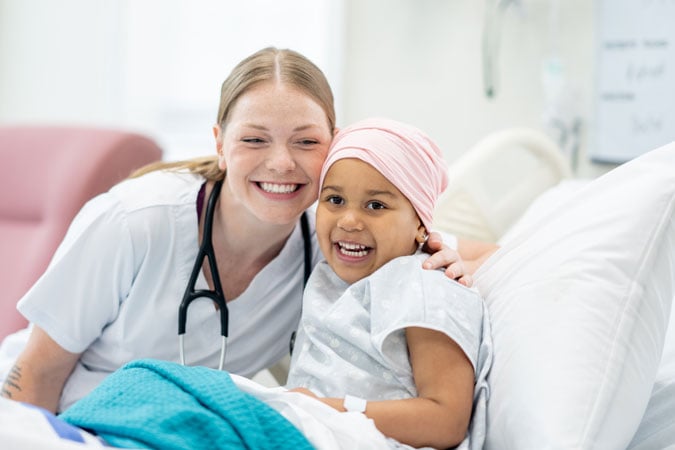
World Cancer Research Fund’s Executive Director of Research and Policy, Dr Giota Mitrou, said: “On International Childhood Cancer Day, it is heartening to see global attention focused on the children and young people, and their loved ones, whose lives are changed by cancer.
We are proud to support studies that help us better understand how nutrition, physical activity and other lifestyle factors influence both risk and survivorship, and to ensure that childhood cancer remains firmly on the health agenda.
Each year, over 400,000 children and adolescents are diagnosed with cancer.
The rate of survival depends on the region. Children and young people with cancer have an 80% chance of survival in most High-Income Countries, but this drops to as low as 20% in Low- and Middle-Income Countries.
International Childhood Cancer Day is held on the 15 February each year. Childhood cancer affects individuals and families all year round, but the day itself provides a moment for us to raise awareness and develop a deeper understanding of the unique issues and challenges faced by those whose lives are touched by childhood cancer.
It also spotlights the need for more equitable and better access to treatment and care for all children with cancer, everywhere.
The World Health Organization (WHO) Global Childhood Cancer Initiative has a goal of increasing the survival rate of children with cancer to at least 60% by 2030, while reducing the suffering and improving the quality of life for all children living with cancer.
This goal can be achieved by increasing capacity to provide quality services for children with cancer around the world, and by prioritising childhood cancer at global, regional and national levels.
The recently-published National Cancer Plan for England places renewed emphasis on improving the nutritional care of children and young people undergoing cancer treatment, recognising that good nutrition is fundamental to treatment tolerance, recovery, and long‑term survival.
This focus on nutrition highlights the wider need for sustained research into childhood cancer that will strengthen our knowledge of how early‑life exposures, diet, physical activity, and environment shape both risk and survivorship.
Across the World Cancer Research Fund (WCRF) network of charities, we are funding studies that explore these factors and their impact on the lives of children and young people affected by cancer.
Using AI chatbots to support families of children with cancer
Dr Micah Skeens was funded by World Cancer Research Fund to test an AI powered chatbot called DAPHNE, designed to identify and manage the social and emotional needs of families caring for a child with cancer.
The research team found that the tool had high usability, and positive feedback from caregivers suggest that it can be an important resource is supporting families. By integrating AI technology into cancer care, it has the potential to revolutionise the identification and management of social needs in paediatric oncology.
Studying Burkitt lymphoma among children in sub-Saharan Africa
Dr Rita Khoueiry is funded by Wereld Kanker Onderzoek Fonds (WKOF) – our network charity in the Netherlands – to understand whether exposure to mycotoxins and infection with Epstein-Barr virus put children at risk of Burkitt lymphoma.
The research is exploring how in-utero and early-life exposure to mycotoxins (toxic compounds produced by fungi) may contribute, in combination with viruses and parasites, to the development of diseases such as Burkitt lymphoma, the most common childhood cancer in sub-Saharan Africa.
Understanding this relationship will set the foundation for developing new prevention strategies to protect at risk children.
Since food contamination with mycotoxins is expected to increase due to climate change, the results are of growing interest worldwide.
The FITco study: Can nutrition and exercise give children with cancer a better chance of survival?
Professor Wim Tissing and Dr Dieuwertje Kok are leading on FITco – a unique long-term study looking at body composition, nutritional intake and exercise in children with cancer.
The FITco study, launched in May 2025, is run by the Princess Máxima Center and Wageningen University & Research, and funded by WKOF.
FITco will follow 500 children newly diagnosed with cancer, tracking their diet, physical activity, and body composition. By understanding how these factors influence treatment, side‑effects, and long‑term health, the team aims to identify better ways to support children during and after cancer therapy.
With strong international collaborations, this research has the potential to shape global standards of supportive care in paediatric oncology.
Real-time tracking of environments and well‑being in young adults with cancer
Dr Katie Darabos is being funded by the American Institute for Cancer Research (AICR) to assess how aspects of the lived environment, and the movement of young adult cancer survivors, influences health behaviours.
Using GPS technology and real‑time surveys, Dr Darabos and team hope to understand how the environments young adults move through each day influence their stress levels, health behaviours, and overall well‑being.
By identifying the types of neighbourhoods or daily settings that increase stress or make healthy choices harder, this research will help pinpoint potential high‑risk environments.
The long‑term impact is significant – it could enable the development of targeted, mobile‑based interventions that support young cancer survivors exactly when and where they need it most.
Smart scans, stronger futures: AI and body composition in paediatric cancer survivorship
Funded by AICR, Dr Paul Yi is developing an AI‑powered tool to analyse routine CT scans and uncover how changes in body composition, such as muscle and fat levels, relate to treatment outcomes in children with cancer.
Right now, it is challenging to predict which survivors of childhood cancer will face serious health impacts down the line.
By revealing patterns that clinicians may not otherwise detect, the insights from this work could transform ongoing survivorship care. This research has the potential to help cancer survivors achieve better long-term health, reduce serious complications that often arise years later, and improve their quality of life.
Diet and exercise to improve treatment outcomes in B‑cell acute lymphoblastic leukaemia
Obesity contributes to the risk for developing acute lymphoblastic leukaemia. It is also known to increase the chance of chemotherapy being less effective and the disease returning in those being treated for it.
Dr Etan Orgel is testing whether targeted diet and physical activity interventions can reduce obesity risk during treatment for B‑cell acute lymphoblastic leukaemia.
This study, funded by AICR, has the potential to identify practical, evidence‑based strategies that make chemotherapy more effective and improve survival outcomes for children and adolescents living with this common childhood cancer.
Digital technologies to understand and improve physical activity in adolescents and young adults
Dr Lisa Schwartz is using innovative tools, including wearable activity monitors and real‑time surveys, to understand the daily factors that influence physical activity in adolescents and young adults with cancer.
By capturing the barriers that prevent young people from being active, this AICR funded research could pave the way for personalised interventions that help them overcome these challenges.
Ultimately, the aim of this research is to assist adolescents and young adults undergoing cancer treatment to be more physically active, which may ease their treatment symptoms and improve their mood and quality of life.