
From plate to policy: how can we make schools healthier places to grow up?
Rates of childhood obesity have increased from 4% to 20% over the past 50 years. From a cancer prevention perspective, this is worrying news: childhood obesity often continues into adulthood, and our work shows that excess body weight in adults is linked to at least 13 different types of cancer. What’s more, our research has shown that higher body weight in childhood, adolescence and young adulthood is linked to an increased risk of colorectal cancer in later life.
To maintain a healthy weight, children need more support to eat a nutritious diet. Policy can help foster systems and structures that make healthy diets easier and, for kids, schools are a great place to start.
The morning bell
My apartment in London overlooks a primary school attended by about 130 students. Waiting for my morning bus to WCRF’s offices, I see parents accompanying their children along the bustling road to the school gates. From a nutrition perspective, this particular route must feel a bit like running the gauntlet: a rotating billboard in view of the bus stop advertises burgers and fries, while every other business sells fast food. UNICEF’s Feeding Profit report, published last year, highlights this as a global problem.
To tackle the food environment around schools, several local authorities in the UK have chosen to restrict the opening of new fast food restaurants around schools. Cities such as Leeds and Manchester have opted to either reduce the number of new outlets near schools or prohibit them entirely.
Elsewhere in the world, governments have chosen to implement school-focused marketing restrictions. Latin American countries are leaders in this space, with countries like Chile and Mexico banning unhealthy foods from being advertised in schools. In 2021, the local congress in Lima, Peru went further, passing a law to prohibit the marketing of unhealthy foods within 200 metres of schools.
Lunchtime
From my own childhood in Canada, memories from the school cafeteria include slices of pizza, chocolate chip cookies and a freezer selling ice cream and popsicles. Although we occasionally managed to bargain for a few dollars for pizza, my parents worried that this menu wasn’t healthy enough. We mostly packed our own, a task added to already busy mornings.
Comparing notes with my partner who grew up in Sweden – where school lunches have been free for all children regardless of income for over 70 years – he remembers a self-service soup and salad bar to go with the daily mains. That didn’t stop students from complaining – tarragon fish day was particularly disliked. In high school, they would occasionally head over to the local pizzeria for lunch when their pocket money stretched to it.
Our memories reflect not only the cross-cutting appeal of pizza but the variation in school meals, even in high-income contexts. Until last year, Canada was still the only G7 country without a school food plan. However, we are not the only ones that have struggled to provide schoolchildren with nutritious lunches. Only 37% of school meal programs have an objective to prevent overweight and obesity, and wealthier countries are more likely to provide unhealthy foods.
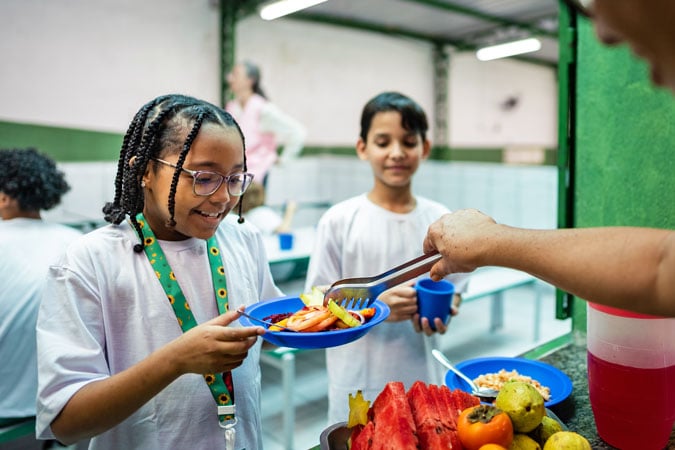
Meanwhile, school food superstars like Brazil show us what can be done, successfully establishing legislation for coverage, quality, and procurement practices, emphasising local foods. In Japan, procurement policies also favour local producers, and pair school meals with food and nutrition education.
Recess
Beyond lunchtime, countries are developing innovative approaches to improving the quality of snacks sold on school premises. In Chile, a suite of policy measures aiming to reduce the consumption of foods high in calories, sugar, sodium or saturated fat has included banning their sale in schools. This has led to an impressive reduction in the sale of these unhealthy foods in school kiosks.
In January of this year, the World Health Organization published its new guideline providing evidence-based recommendations to support countries in creating healthy school food environments. This cites evidence from countries like Chile, as well as measures to directly provide children with healthy alternatives, like the European Union’s school scheme to support the distribution of milk, fruit and vegetables. Meanwhile, the School Meals Coalition, a global multi-partner initiative, facilitates country commitments to initiate or strengthen school food programmes, and fosters collaborations to support their efforts.
From the morning bell to lunchtime to recess, every part of the school day offers an opportunity to shape healthier futures. World Obesity Day calls on us to advocate for stronger food policy and equitable access to nutritious foods. If we get this right in schools, we don’t just change what children eat today – we help reduce their cancer risk tomorrow.
More policy-related news and blogs



Preventing cancer. Saving lives
While society continues to search for a cure, our prevention and survival work helps people to live longer, healthier lives – free from the devastating effects of cancer.