
About bowel cancer
Find out what bowel cancer is, how it develops and who it affects.

On this page
What is bowel cancer?
Being diagnosed with bowel cancer and going through treatment can be a challenging time physically, mentally and emotionally.
Bowel cancer, also known as colorectal cancer, is cancer that can develop anywhere in the large bowel, which includes the colon and the rectum.
The bowel is part of the digestive system and is made up of the small bowel and the large bowel. Most nutrients from the food we eat are absorbed in the small bowel. What is left then moves into the colon, where water and any remaining nutrients are absorbed. This turns the waste into solid poo, which travels to the rectum before leaving the body.
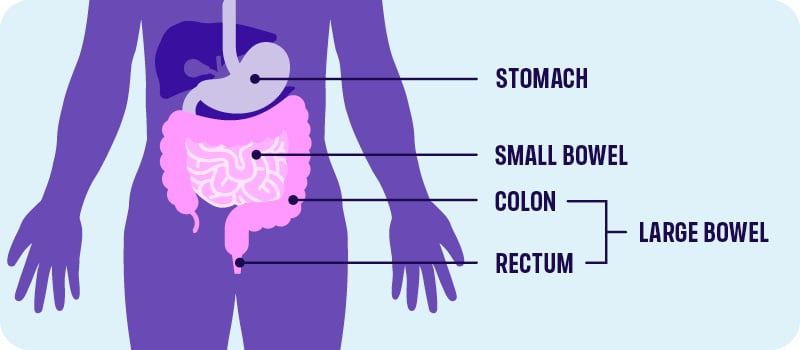
Bowel cancer develops when cells in the lining of the bowel become damaged and start to grow in an uncontrolled way, forming a tumour. It can also develop from small growths called polyps. These are not cancerous, but some can turn into cancer over time. If polyps are found, they are usually removed.
FAQ: What’s the difference between bowel, colon, rectal and colorectal cancer?
These terms refer to where the cancer starts in the large bowel.
Colorectal cancer is the name researchers use for cancers of both the colon and the rectum. When the cancer starts in a specific part of the large bowel, it is called colon cancer or rectal cancer.
For the public, the term bowel cancer is most commonly used.
How common is bowel cancer?
In the UK, bowel cancer is the 4th most common cancer. In 2022/2023, there were 49,364 new cases. Globally, there were 1,926,425 new cases, making it the third most common cancer worldwide.
Who does bowel cancer affect?
Bowel cancer affects both men and women, but in the UK, more than half of all new cases are diagnosed in men.
Research shows that bowel cancer is less common in Asian, Black and mixed or multiple ethnic groups than in white ethnic groups. However, people from non-white backgrounds have higher rates of bowel cancer at a younger age.
Raising awareness of bowel cancer symptoms and screening, and making sure care is accessible and inclusive for all communities, can help improve outcomes for everyone.
What age is bowel cancer most common?
Bowel cancer is much more common as people get older. Over 90% of new cases are diagnosed in people over 50 years old.
However, bowel cancer can affect people of any age. In the UK, more than 2,300 people under 50 are diagnosed with bowel cancer each year.
Stay aware, know what’s normal and get checked early
Bowel cancer can affect anyone, and finding it early gives you the best chance of successful treatment. To get checked early, know the signs of bowel cancer, speak to your GP if you notice any unusual changes and attend bowel cancer screening when invited.
Visit the NHS website for more information and support.
More bowel cancer information for you



Page last reviewed: March 2026
-
References
- What is bowel cancer? [Internet]. 2026. Available from: https://www.nhs.uk/conditions/bowel-cancer/what-is-bowel-cancer/
- Bowel Cancer UK. The bowel [Internet]. 2024. Available from: https://www.bowelcanceruk.org.uk/about-bowel-cancer/the-bowel/
- Bowel Cancer UK. Bowel cancer [Internet]. 2024. Available from: https://www.bowelcanceruk.org.uk/about-bowel-cancer/bowel-cancer/
- World Cancer Research Fund/ American Institute for Cancer Research. Diet, nutrition, physical activity and colorectal cancer [Internet]. 2018. Available from: https://www.wcrf.org/research-policy/library/colorectal-cancer-systematic-literature-review/
- Cancer Research UK. Bowel cancer statistics [Internet]. Available from: https://www.cancerresearchuk.org/health-professional/cancer-statistics/statistics-by-cancer-type/bowel-cancer.
- Delon C, Brown KF, Payne NWS, Kotrotsios Y, Vernon S, Shelton J. Differences in cancer incidence by broad ethnic group in England, 2013–2017. Bri J Cancer [Internet]. 2022 Mar 2;126(12):1765–73. Available from:https://doi.org/10.1038/s41416-022-01718-5.
- Birch RJ, Burr NE, Taylor JC, Downing A, Quirke P, Morris EJA, et al. Inequalities in colorectal cancer diagnosis by ethnic group: a population-level study in the English National Health Service. BMJ Open Gastroenterol [Internet]. 2025 Jan 1;12(1):e001629. Available from:https://doi.org/10.1136/bmjgast-2024-001629.
UK cancer statistics based on combined data from England, Scotland, Northern Ireland and Wales. World Cancer Fund, 2024. International cancer statistics from Globocan.