Healthy lifestyle shown to lower risk of death after cancer diagnosis

New evidence, published today, shows that sticking to five lifestyle recommendations improves survival after a later cancer diagnosis.
The findings provide encouraging evidence that simple, achievable habits established before a cancer diagnosis can play a role in improving long-term health and the health of those following a cancer diagnosis.
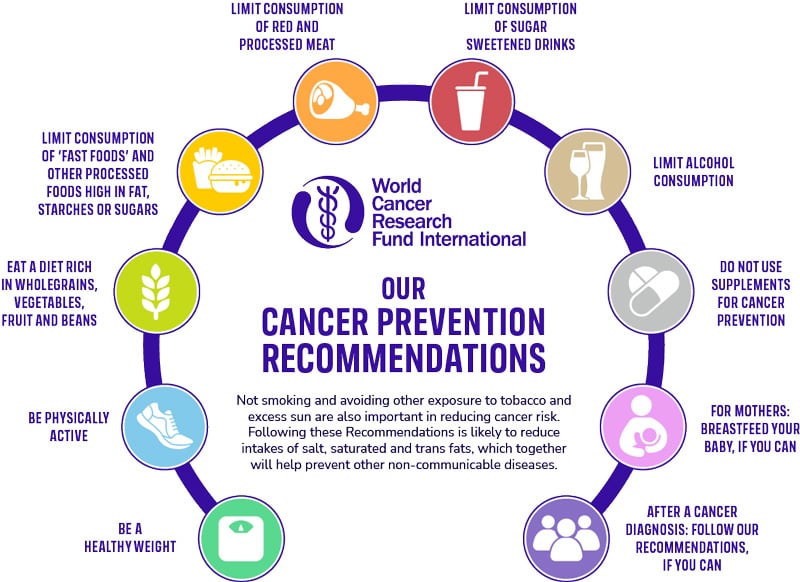
The Cancer Prevention Recommendations analysed in the study include:
- Be a healthy weight
- Be physically active
- Eat wholegrains, vegetables, fruit and beans
- Limit red and processed meat
- Limit alcohol consumption
The latest research led by Newcastle University, UK, published in Cancer was funded by Wereld Kanker Onderzoek Fonds, (WKOF) – the Netherlands-based charity within theWorld Cancer Research Fund International network of charities that also includes World Cancer Research Fund and the American Institute for Cancer Research.
The Recommendations were developed in 2018 by World Cancer Research Fund (WCRF) and the American Institute for Cancer Research (AICR) as evidence-based lifestyle guidance which aim to reduce cancer risk.
Although previous research in cancer survivors has indicated some positive effects, this new study provides the most comprehensive evidence to date of their association with improved survival for people living with and beyond cancer.
Professor John Mathers, Emeritus Professor of Human Nutrition at Newcastle University, who led the study, said:
“This research is incredibly exciting because, for the first time, we have shown that higher adherence to the WCRF/AICR 2018 Recommendations may reduce the risk of mortality for people diagnosed with cancer in a UK cohort.
The results of this paper add to an existing body of evidence on the WCRF/AICR Recommendations and cancer survivors and could be informative for those developing policies and clinical guidelines to improve health and longevity following a cancer diagnosis.”
Breaking down the results
The research team assessed the dietary and lifestyle data of 28,550 individuals who were assigned score points from 0-5 in relation to how closely the Recommendations were followed at the time of recruitment to the Biobank, prior to a cancer diagnosis. The UK Biobank is a large, population-based database, established to allow detailed investigations of the genetic and nongenetic determinants of the diseases of middle and old age.
Based on decades of research, the key WCRF/AICR Recommendations were developed in 2018.
The research team found that each 1-point increment in score, equivalent to fully meeting one Recommendation, was associated with an 8% lower chance of dying from any cause over time. Overall, having a score in the highest third of the study population was associated with a 16% lower chance of all-cause mortality, compared with those in the lowest third.
This association was consistent regardless of whether the individual smoked and also held true for multiple cancer types such as breast and liver cancers, suggesting broad survival benefits.
Calls for interventions for healthy living
The findings show that following a healthy lifestyle is not only important for cancer prevention but may also have implications for long-term health after a cancer diagnosis.
Dr Fiona Malcomson, researcher at Newcastle University and co-author of the paper said:
“The take home message is that the 2018 WCRF/AICR Cancer Prevention Recommendations apply to cancer survivors too. Having a healthier eating pattern, being more physically active and avoiding being too heavy, as described in the Recommendations, is associated with better long-term outcomes for those living with and beyond cancer.
The scientists behind the research suggest that these findings support prioritising the development of interventions to enhance adherence to the WCRF/AICR Recommendations– including after diagnosis – that may potentially lower mortality risk among people diagnosed with cancer. This means that cancer survivors can take action to improve their health and should be encouraged to do so by healthcare providers.”
Nadia Ameyah, Director of WKOF, the Netherland-based charity within WCRF International said:
“This tremendously exciting study further cements the status of our evidence-based Recommendations as one of the best ways of maintaining your health when living with and beyond cancer. We have always prided ourselves on the scientific grounding of our Recommendations for primary prevention, and this is the first time we have had such robust evidence for survivorship. Cancer survivorship and quality of life after cancer diagnosis are key priorities of WKOF.
We look forward to seeing how these findings will inform health policy and the design of healthcare interventions to help those living with and beyond cancer to live happier, healthier lives.”