

Grant title: From Inflammatory Lifestyle to Tumour Immunity: Unravelling Aetiologic Pathways Through Integrative Epidemiology
Institution: Netherlands Cancer Institute
Grant awarded: September 2026
Funded by: Wereld Kanker Onderzoek Fonds
Inflammation is a process affected by many factors, but we know little of how this works in breast cancer. We will study whether lifestyle habits that promote inflammation in the body, together with inherited DNA variants, are linked to the immune cells found in breast tumours. We will also investigate how these impact the risk of developing a first breast cancer, or a second breast cancer in the opposite breast. By bringing together information on lifestyle, tumour immune cells and genetics, we aim to better understand each woman’s individual risk.
By better understanding how systemic treatments, genetics and lifestyle together shape the risk of a second breast cancer, we aim to make health care fit every person better, with fewer side effects. Wereld Kanker Onderzoek Fonds support brings us a step closer to that, and for that we are very grateful.Professor Marjanka Schmidt
🔍 Click image to enlarge
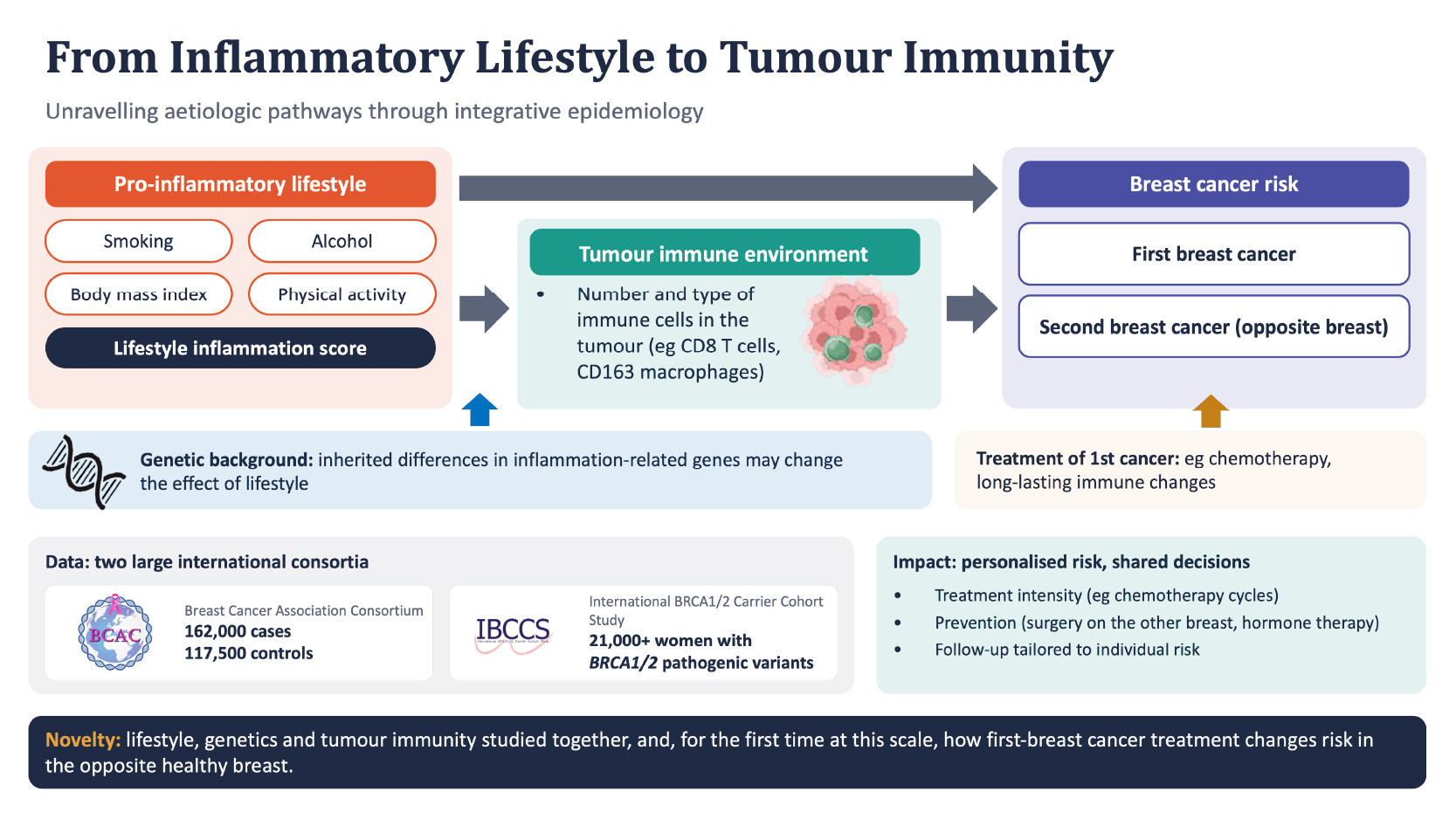 Graphical abstract provided by Professor Marjanka Schmidt
Background
Breast cancer is influenced by many factors, including our genetics, environment, and lifestyle. One important link between these factors is inflammation. Inflammation is part of the body’s defence system, but when it becomes long-lasting, it can weaken the immune system and make it easier for cancer cells to grow.
Certain lifestyle habits, such as being overweight, not doing enough physical activity, smoking, and drinking alcohol, can contribute to this type of chronic inflammation. Some people may be more affected by these habits because of inherited differences in genes related to inflammatory processes.
Inflammation can also influence what happens inside breast tumours. It may affect which immune cells enter the tumour and how well these cells can recognise and attack cancer. For women who develop cancer in the other breast later on, treatments for the first tumour (such as chemotherapy) can cause long-lasting changes in the immune system. These treatment effects may interact with lifestyle habits and further influence cancer risk.
Aims and objectives
This project aims to understand:
- How lifestyle habits that promote inflammation influence the number and type of immune cells in a tumour.
- How these pro-inflammatory lifestyle habits relate to the risk of developing a first or second breast cancer.
- Whether the effect of lifestyle on breast cancer risk differs depending on a person’s genetic background, especially genes involved in inflammation.
- Whether treatments for the first breast cancer change how lifestyle and genetics affect the risk of cancer in the other breast.
How it will be done
This study will use information from two large international collaborations. These are the Breast Cancer Association Consortium, including data from over 162,000 women with, and 117,500 without, breast cancer worldwide and the International BRCA1/2 Carrier Cohort Study, including more than 21,000 women with pathogenic variants in the BRCA1 or BRCA2 gene. These datasets include detailed information on lifestyle factors, inherited genetic differences, breast cancer treatments, and the presence of different immune cells inside the tumour.
By analysing these data, we will explore:
- How a lifestyle inflammation score based on smoking, alcohol, body mass index and physical activity relates to the presence of immune cells within tumours.
- How the lifestyle inflammation score relates to first and second breast cancer risk.
- How small variations in our DNA (genetic variants) may affect these relationships.
- How treatment of the first breast cancer may change these relationships with respect to the risk of a second tumour.
Potential impact
By combining information about lifestyle, the presence of immune cells within tumours, and genetic factors, we can better understand a woman’s individual risk. This more complete approach can help in shared decision-making about how strong her treatment should be (for example, how many cycles of chemotherapy), preventive options, such as surgery on the other breast or hormone therapy, and personalised follow-up plans tailored to her risk. Overall, this research may help women make informed choices and improve breast cancer prevention and care.
Scientific novelty
This research brings together lifestyle, genetics and the immune environment inside breast tumours to understand how inflammation may link everyday behaviours to breast cancer risk, rather than studying these factors separately. For the first time at this scale, the project will investigate how these relationships may change after breast cancer treatment and influence the risk of developing cancer in the other breast.