

Grant title: Harnessing Exercise-Induced Redox Control of Cytotoxic Lymphocytes for Improved Anti-tumour Immune Surveillance (REACT)
Institution: Karolinska Institute
Grant awarded: September 2026
Funded by: Wereld Kanker Onderzoek Fonds
We know that exercise benefits people with cancer, but we still don’t fully understand how. REACT allows us to explore how the metabolic changes that happen with every exercise session can shape the function and responsiveness of our immune system, and support anti-tumour immune surveillance. We are deeply grateful for the funding provided by the Wereld Kanker Onderzoek Fonds, as part of the World Cancer Research Fund International grant programme, to advance our knowledge in this field of research.Dr Helene Rundqvist
🔍 Click image to enlarge
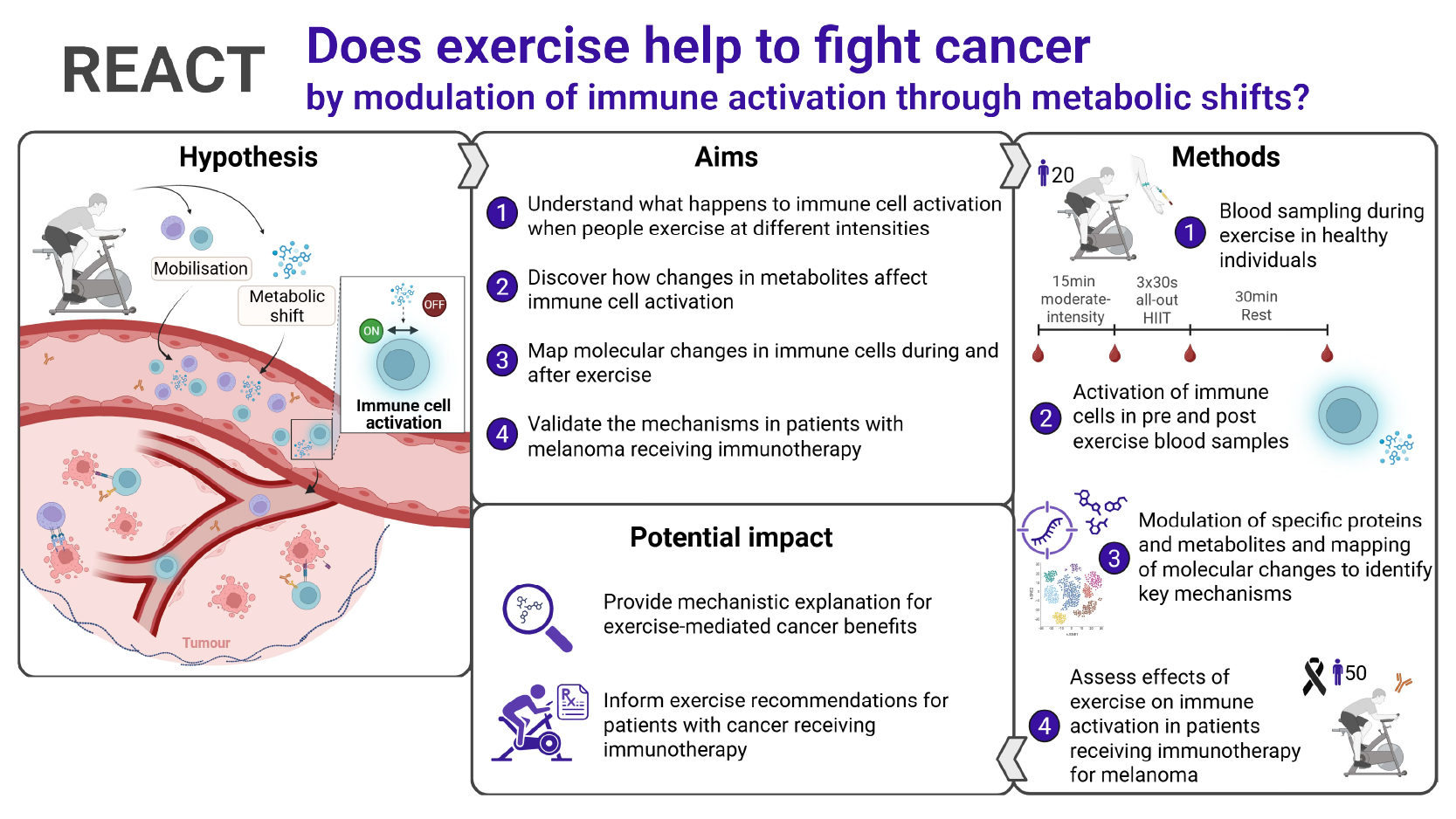 Graphical abstract provided by Dr Helene Rundqvist
Background
Exercise holds the potential to improve survival in patients with cancer. Observational studies associating physical activity with improved survival were recently complemented by the CHALLENGE trial, which demonstrated that bowel cancer patients who were randomised to an exercise intervention following chemotherapy had better survival rates than patients who received health-education materials alone. The biological mechanisms of how exercise helps fight cancer are not fully understood.
When you exercise, blood chemistry changes and becomes more acidic, with higher levels of lactate and lower levels of bicarbonate. Simultaneously, immune cells called lymphocytes (your body’s cancer-fighting soldiers) pour into your bloodstream. After exercise, these cells travel throughout your body, potentially reaching tumours where they can attack cancer cells.
Scientists in the team discovered that bicarbonate plays a surprising role in controlling how immune cells activate. When bicarbonate combines with hydrogen peroxide in cells, it creates a powerful oxidising molecule that acts like a switch, controlling immune cell activation signals. During exercise, when bicarbonate levels drop, this switch changes, potentially priming immune cells to fight cancer more effectively once the body returns to a resting state.
Aims and objectives
We believe exercise changes immune cells’ ability to fight cancer by temporarily altering the chemical environment around their activation signals. Our aims are to:
- Understand what happens to immune cell signalling when people exercise at different intensities.
- Discover how drops in bicarbonate and blood acidity affect the ability of specific immune cells, called T-cells, to activate and attack cancer.
- Map molecular changes occurring in immune cells during and after exercise.
- Use this knowledge to develop better exercise recommendations for patients with cancer including those receiving immune therapy.
How it will be done
We will study 20 healthy volunteers performing moderate and intense-sprint exercises on stationary bikes. Blood samples will be collected before exercise, after moderate-intensity exercise, after high-intensity exercise and 30 minutes into recovery, and the response to activation signals in the changed environment will be tested.
In laboratory experiments, we will activate immune cells in before and after exercise conditions. Specific proteins controlling bicarbonate and the cell’s protective system will be modified to understand their role. Advanced techniques will simultaneously analyse thousands of proteins and their chemical modifications, creating a comprehensive picture of exercise effects on immune function.
Our findings will be validated in samples obtained before and after a single exercise session, from patients receiving immune therapy for melanoma.
Potential impact
This project will provide an explanation for cancer benefits driven by exercise. In the long term, the knowledge obtained will be used to develop personalised exercise prescriptions based on the effects of metabolic shifts on immune function. This can inform intensity and frequency recommendations and how to combine exercise with a certain therapy – immune checkpoint inhibitor therapy. Most importantly, enhanced knowledge will empower cancer patients with safe, practical actions with established effects to support quality of life and cancer-specific outcomes.
Scientific novelty
This is the first study connecting changes in the body’s chemistry from exercise to changes in immune cell activation, providing information on how the body primes immune cells to fight cancer during exercise.