

Grant title: Metabolomic Signatures of Traditional Diets and Breast Cancer Risk in Black South African Women
Institution: South African Medical Research Council
Grant awarded: September 2026
Funded by: Wereld Kanker Onderzoek Fonds
“Breast cancer remains a major public health challenge. I am grateful to the Wereld Kanker Onderzoek Fonds for supporting this project, which will use untargeted metabolomics to better understand how traditional dietary patterns may help protect African women from breast cancer. In addition, it will help me develop skills in nutritional epidemiology, metabolomics, and breast cancer research.”
Dr Mwiza Singini
🔍 Click image to enlarge
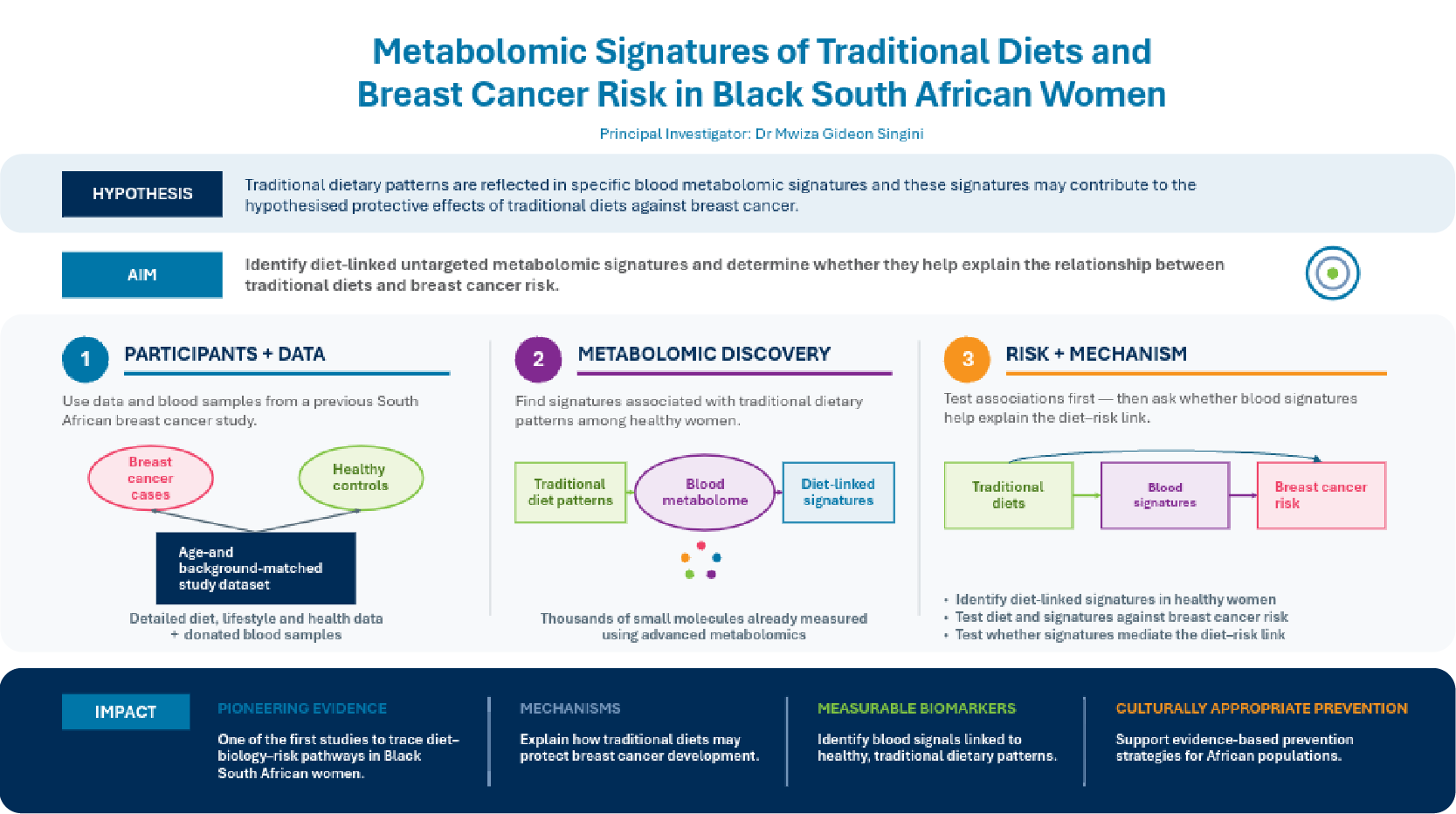
Graphical abstract provided by Dr Mwiza Singini
Background
Breast cancer is the most common cancer affecting women worldwide, with millions diagnosed each year. In South Africa, black women bear a heavy burden from this disease, and many are diagnosed too late for effective treatment. Over the coming decades, breast cancer rates across Sub-Saharan Africa are expected to double as populations age and lifestyles become more westernised.
Several risk factors for breast cancer are well established, such as excessive alcohol consumption, obesity, physical inactivity, and certain hormonal and reproductive factors in westernised populations. However, these known factors only partly explain rising cancer rates. Recent research from Soweto made an important discovery – that women who maintain traditional dietary patterns have a lower risk of developing breast cancer. This suggests that traditional foods may offer protection, but the biological reasons remain unclear.
Metabolomics is a scientific technique that can measure hundreds to thousands of small molecules called metabolites in the blood. These metabolites act like chemical snapshots, revealing how our bodies respond to different foods. Some metabolites may be influenced by traditional dietary patterns and may hold the key to understanding their protective effects. While researchers have successfully used metabolite patterns in other studies, no one has yet identified specific blood markers that link traditional dietary patterns to breast cancer protection.
To reduce breast cancer rates and develop prevention approaches that are relevant to African populations, we need to understand exactly how traditional diets protect women. Identifying these dietary blood markers is an essential step towards that understanding.
Aims and objectives
This study aims to identify new markers in blood that are linked to traditional dietary patterns. We will then investigate whether these blood markers are associated with breast cancer risk. Finally, we will explore whether these markers can explain why traditional diets seem to protect women from developing breast cancer.
How it will be done
We will use data from black women in Soweto who took part in an earlier South African Breast Cancer study. These women completed questionnaires about their eating habits and lifestyle and gave blood samples. Scientists have already measured thousands of metabolites in their blood using advanced technology. The study includes both women who developed breast cancer and healthy women of similar ages and backgrounds who had not developed breast cancer. Using data analysis software, we will first identify which blood molecules are characteristic of traditional African diets. Next, we will examine whether women with these diet-related blood markers have lower breast cancer risk. Finally, we will test whether these blood markers account for the protective effect of traditional foods.
Potential impact
Our findings could lead to new prevention strategies and help preserve healthy, traditional eating practices in African communities. The findings may also help to identify women at risk before breast cancer develops.
Scientific novelty
The innovative aspect of this project will be identifying unique blood patterns of traditional diets that could reveal how customary African foods protect against breast cancer. This will deepen our understanding of the biological processes involved.