Regular Grant Programme
The aim of the World Cancer Research Fund Regular Grant Programme is to support innovative and original research into the role of diet, nutrition, body composition and physical activity in either cancer prevention or cancer survivorship.
Timelines
The WCRF International grant calls for 2026-27 will open on 5 October 2026.
Please check this page closer to the opening date for further information and a link to apply.
Our funders and eligibility
From autumn 2026, WCRF International will manage grants on behalf of the whole network: World Cancer Research Fund in the United Kingdom, Wereld Kanker Onderzoek Fonds in the Netherlands and the American Institute for Cancer Research in the United States. Therefore, the Regular Grant Programme will now be open to researchers anywhere in the world.
Research priority areas
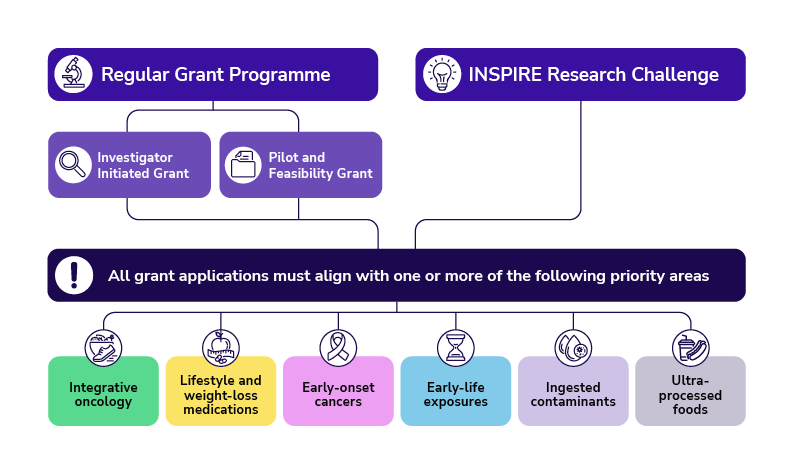
To focus this expanded programme where it can have the greatest impact, our 2026-27 grant calls will include six priority areas, identified through evidence gaps highlighted by the Global Cancer Update Programme, our strategic objectives and consultation with our scientific stakeholders.
For the 2026-27 grant call, applications must focus on at least one of the six priority areas. Applications may span more than one priority area where this is scientifically justified; applicants should identify all relevant areas and make the main alignment of the proposed research clear. Alignment with a priority area does not replace the usual requirements for scientific quality, relevance to WCRF International’s remit, feasibility and potential impact. For this year’s grant call, sleep will be included as a primary exposure alongside diet, nutrition, physical activity and body composition.
-
1. Integrative oncology
This priority area focuses on diet, physical activity, body composition, sleep, prehabilitation and other relevant supportive-care interventions delivered alongside conventional cancer treatment in childhood and adulthood. Research should determine which interventions work, for whom and at what stage of the cancer pathway, and how they can be incorporated safely and effectively into routine oncology care.
Studies should address outcomes that matter to patients and for clinical practice, including treatment tolerance and toxicity, quality of life, physical function, symptom control, recurrence and longer-term health. Applications on broadly or loosely defined complementary therapies that do not have a clear link to WCRF International’s remit or that lack a strong scientific rationale, are outside the intended scope of this priority area.
-
2. Lifestyle and weight-loss medications
This priority area examines how diet, physical activity and behavioural support can be integrated with weight-loss medications, including GLP-1-related medicines across cancer prevention, treatment and survivorship. Research should address cancer-specific benefits and risks, including cancer incidence and relevant risk biomarkers, nutritional status, body composition and lean-mass preservation, physical function, treatment tolerance and effectiveness, quality of life, recurrence and survival.
Studies should consider the timing, duration and discontinuation of weight-loss medications, and seek to distinguish the effects of the medications themselves from those attributable to weight loss, metabolic improvements and lifestyle changes. Research should also examine whether effects vary by medication, cancer type, treatment stage or population characteristics, and consider inequalities in access and use where relevant.
-
3. Early-onset cancers
This priority area seeks to explain the increasing incidence and prevalence of early-onset cancers to establish whether their modifiable risk factors and biology differ from cancers diagnosed later in life. This call considers cancers diagnosed in early adulthood, defined as 18-50 years old. Research may consider lifecourse exposures, including diet, body composition, physical activity and sleep, alongside tumour characteristics and relevant biological pathways.
-
4. Early-life exposures
This priority area investigates how modifiable exposures from preconception through pregnancy, infancy, childhood and adolescence influence cancer risk later in life (defined as adulthood, 18+ years). Research should define the exposure precisely and, where appropriate, define the approach/model being used within the study (for example, critical developmental window/sensitive period, accumulation, trajectory, pathway, social mobility or mixed model) and may consider maternal, paternal and intergenerational factors, diet, growth, body composition, physical activity, sleep and relevant ingested exposures.
The long interval between early-life exposure and cancer means that studies should use robust methods to address familial and socioeconomic confounding and, where possible, combine epidemiological evidence with biomarkers or mechanistic evidence.
-
5. Ingested contaminants
This priority area investigates the role of ingested contaminants in food and drinking water in cancer prevention and survivorship. Relevant exposures may include endocrine-disrupting chemicals, pesticides, heavy metals, persistent organic pollutants and micro- and nano-plastics, where there is a clear and evidence-based rationale for cancer relevance.
Research should consider cumulative exposure and mixtures, identify credible biological or causal pathways, and distinguish the effects of ingested contaminants from those of overall diet, occupation, air pollution and correlated social or geographical factors.
-
6. Ultra-processed foods
This priority area seeks to clarify whether and how ultra-processed food consumption influences cancer risk and survivorship. Research should move beyond associations based solely on broad ultra-processed food classification systems to identify whether specific processing characteristics, additives, changes to food structure or related biological pathways may be causal.
Studies should address limitations in food classification and dietary assessment, account for changes in the food supply over time, and distinguish the effects of processing from those of energy intake, body composition, overall diet quality, the nutritional composition of individual foods and other relevant determinants of health.
Exposure data must reflect, or demonstrate clear relevance to, contemporary products and consumption patterns. Applications that do not adequately account for changes in food formulation, processing and consumption over time will not be considered.
Investigator initiated grants
- Eligible applicants: lead applicants must hold a research position at the host institution for the duration of the project.
- Eligible organisations: anywhere in the world
- Level of funding: up to £500,000
- Duration of funding: up to 4 years
Pilot and feasibility grants
- Eligible applicants: lead applicants must hold a research position at the host institution for the duration of the project.
- Eligible organisations: anywhere in the world
- Level of funding: up to £60,000
- Duration of funding: up to 2 years
If you have any queries, please email research@wcrf.org
“Our World Cancer Research Fund-funded research sheds new light on the mechanisms linking adult body size and energy restriction in youth to cancer risk. Our results identified that there are critical time-windows of exposure with regards to cancer, and that hormonal, growth and metabolic pathways are already important at a young age for the risk of colorectal and breast cancer over age 55 years” – Prof Matty Weijenberg, grant holder

Information for grant holders
If you currently receive funding from World Cancer Research Fund International and have any questions, please see our information for research grant holders