

Grant title: Exercise-Driven Vascular Normalisation and T-Cell Metabolic Fitness to Enhance Cancer Immunotherapy
Institution: Weill Cornell Medicine
Grant awarded: September 2026
Funded by: American Institute for Cancer Research
“Receiving this grant from the American Institute for Cancer Research is a great honor. Immunotherapy has transformed cancer treatment, yet many patients still do not benefit from it. Our project will explore how exercise reshapes tumor blood vessels and boosts the fitness of immune cells, with the aim of determining whether physical activity can act as a complementary strategy to make immunotherapy work for more patients. I am deeply grateful for this support.”
Dr Giorgia Colombo
🔍 Click image to enlarge
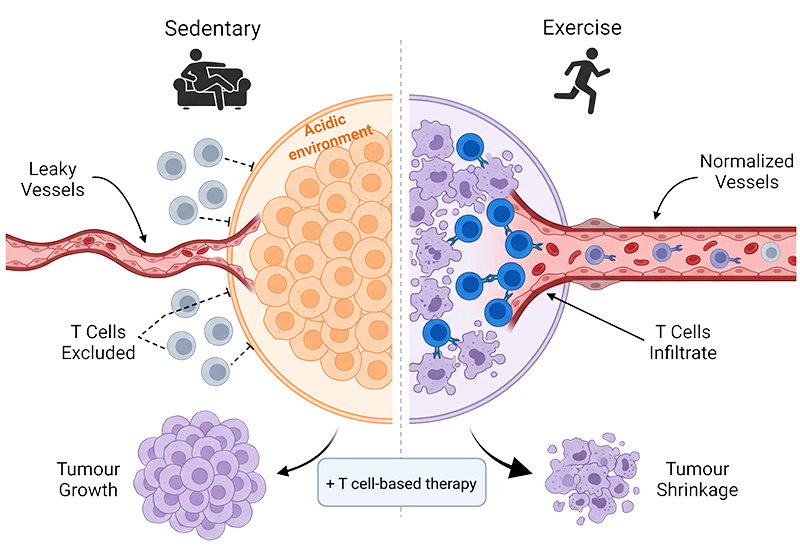
Graphical abstract provided by Dr Giorgia Colombo
Background
Immunotherapy has revolutionised cancer treatment by helping the immune system attack tumours. However, these therapies do not work in many patients because tumours can prevent immune cells from functioning properly. Many cancers rely heavily on sugar metabolism and create an acidic environment that weakens immune cells and damages blood vessels, which then limits the ability of immune cells to reach and destroy cancer cells. Exercise is known to improve blood vessel function, increase circulation of immune cells, and support overall metabolic health.
Aims and objectives
This project will investigate whether physical activity can improve cancer immunotherapy by strengthening immune cells and improving tumour blood vessel structure in order to help immune cells attack the tumour core.
How it will be done
Using mouse models of breast cancer, we will study how exercise influences tumour blood vessels, immune cell function, and the metabolism of tumour-fighting T-cells in the immune system. We will also test whether immune cells generated from physically active animals perform better when transferred into non-physically active mice with cancer.
Potential impact
By understanding how exercise reshapes the tumour environment and immune responses, this research may reveal new ways to support cancer immunotherapy using safe, lifestyle-based interventions. Ultimately, this study could provide evidence for physical activity as a supportive intervention that boosts the benefits of immunotherapy for patients with cancer.
Scientific novelty
Currently, no non-pharmacological strategies are available that can simultaneously improve T-cell function and remodel tumour blood vessels at the same time. This study would provide support for physical activity as an inexpensive method for improving immune system activation and remodelling well-functioning blood vessels at the same time.