

Grant title: Impact of a comprehensive lifestyle medicine programme on prognostic and cardiometabolic risk factors in breast cancer survivors
Institution: Kaiser Foundation Research Institute, a division of Kaiser Foundation Hospitals
Grant awarded: September 2026
Funded by: American Institute for Cancer Research
“We are deeply grateful to the American Institute for Cancer Research for supporting this important research. As more women survive breast cancer than ever before, there is a growing need to address the long-term health challenges they face beyond cancer itself. This study will help us better understand how a comprehensive lifestyle medicine approach, which includes healthy eating, physical activity, sleep, stress management, avoidance of risky substances, and social connection, can improve cardiometabolic health among breast cancer survivors. We are hopeful that these findings will help advance survivorship care and improve long-term health outcomes for breast cancer survivors.”
Dr Isaac Ergas
🔍 Click image to enlarge
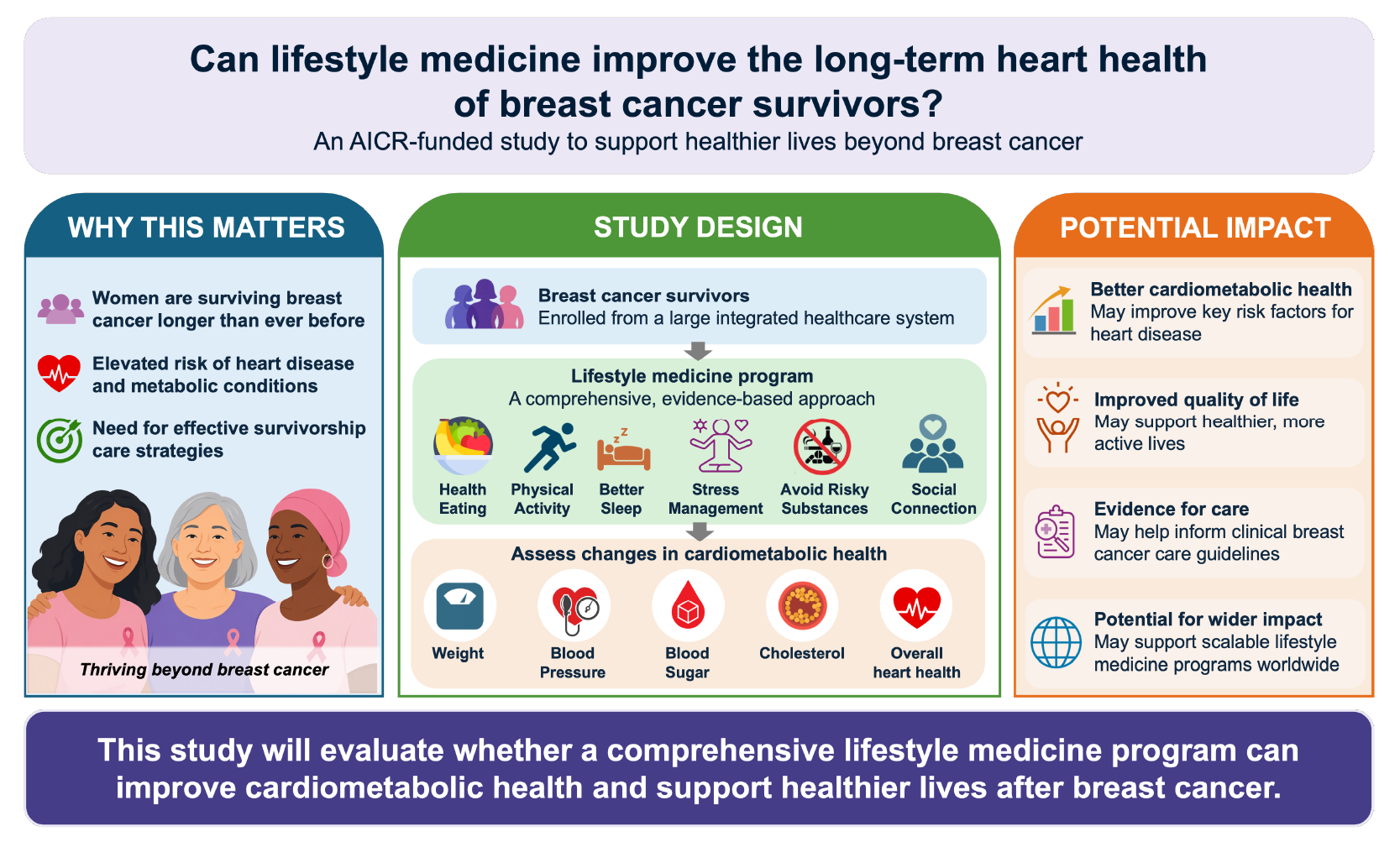
Graphical abstract provided by Dr Isaac Ergas
Background
Women who have had breast cancer are living longer, but many face increased risks of heart disease and related conditions such as high blood pressure, diabetes, and high cholesterol. Heart disease is now a leading cause of death among people living with breast cancer. These risks may be linked to cancer treatments as well as lifestyle changes after diagnosis. Healthy behaviours such as eating well, staying active, managing stress, and getting enough sleep can improve health, but we do not yet fully understand how programmes that support these behaviours work in real-world healthcare settings.
Aims and objectives
We believe that taking part in a comprehensive Lifestyle Medicine programme will improve heart health among people living with breast cancer. We also aim to understand which lifestyle changes are most important, and whether some individuals benefit more than others based on their health at the start of the programme.
Our goals are to:
- Measure changes in weight, blood pressure, blood sugar, and cholesterol.
- Identify which lifestyle changes are most strongly linked to improvement.
- Explore whether markers of inflammation in the blood influence how people respond to the programme.
How it will be done
This study will take place within Kaiser Permanente Northern California, a large healthcare system. We will study about 500 people living with breast cancer who participated in a Lifestyle Medicine programme and compare them to similar individuals who did not participate. We will use existing health records to track changes over time and use information collected as part of the programme, including surveys about lifestyle habits and blood samples, to better understand how and why changes occur.
Potential impact
In the short term, this study will provide information about whether a Lifestyle Medicine programme can improve health among people living with breast cancer in a real-world setting. It will also help identify which patients and lifestyle changes matter most. In the long term, this research could guide the development of more effective, widely available programmes to support this population’s health, reduce heart disease risk, and improve quality of life.
Scientific novelty
This study is unique because it examines a comprehensive lifestyle programme that addresses multiple aspects of health, rather than focusing on a single behaviour. It also combines medical records, patient-reported data, and blood samples to provide a more complete picture of how lifestyle changes affect health. By studying this programme in a real healthcare setting, the findings will be directly relevant to improving care.