

Grant title: From liver disease to hepatocellular carcinoma: projecting prevention impact of physical activity and sleep in population cohorts
Institution: International Agency for Research on Cancer (IARC)
Grant awarded: September 2026
Funded by: World Cancer Research Fund
“Knowing that physical activity and sleep matter for liver health is not enough. To guide policymakers and clinicians, we need to know what difference improving them would make across a population: how many liver cancers could be prevented, who would benefit most, and at what cost. I am very grateful to the World Cancer Research Fund and to everyone who supports it, for making this work possible.”
Dr Felix Boekstegers
🔍 Click image to enlarge
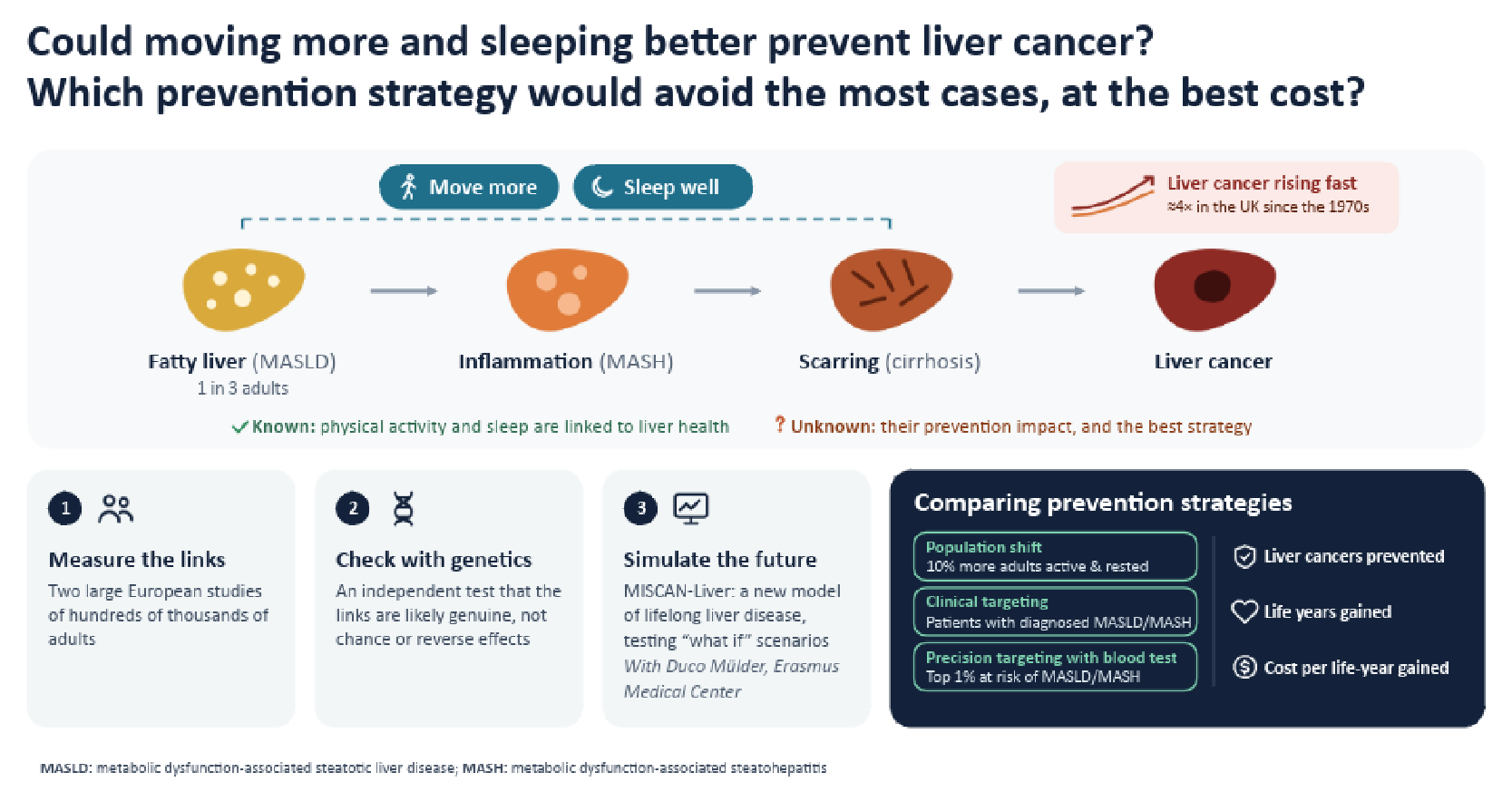
Graphical abstract provided by Dr Felix Boekstegers
Background
Liver cancer is one of the deadliest cancers, and it is becoming more common across Europe. In many adults, it develops after years of unnoticed liver damage caused by fatty liver disease, which can lead to inflammation and scarring before cancer appears. There is growing evidence that daily behaviours, such as being more physically active and sleeping well, may help slow or prevent harmful changes in the liver. However, most studies only describe links. They cannot show how many cases of serious liver disease or liver cancer would be prevented if people improved these behaviours in real life. Nor do they compare different ways of encouraging such changes, for example, across the whole population or only in people at high risk, in terms of their benefits and their costs. As a result, doctors and policymakers still lack the evidence needed to guide prevention efforts.
Aims and objectives
This project is based on three ideas:
First, being inactive and sleeping poorly may speed up the development of serious liver disease and, over time, raise the risk of liver cancer.
Second, these effects are likely to be genuine, rather than due to chance or to early liver problems making people less active or affecting their sleep.
Third, improving physical activity and sleep, even modestly, may reduce the number of people who go on to develop liver cancer and may help people live longer and healthier lives.
To study this, we will analyse large population studies, use genetic approaches to test whether the relationships are genuine, and build a new computer model to estimate and compare the long term benefits and costs of different prevention strategies.
How it will be done
The project uses health, lifestyle and biological data from two large European cohorts. These studies follow hundreds of thousands of adults over many years. They include detailed information on daily activity, sleep habits and early signs of liver disease.
Together with modelling experts at Erasmus University Medical Center (Rotterdam, the Netherlands), we will also develop the first version of MISCAN Liver, a computer model that can simulate how liver disease and liver cancer develop over a lifetime. We will use it to explore different “what if” prevention scenarios. For example, what would happen if a small share of adults became more active, or if support was offered to people at higher risk?
Potential impact
In the short term, the project will provide clearer evidence on how physical activity and sleep relate to liver disease and liver cancer. It will also produce the first estimates of how many cases different prevention strategies could prevent, how many years of healthy life they could gain, and at what cost.
In the long term, the model will help guide targeted prevention strategies, support future guidelines, and provide a flexible tool that can be expanded to include other behaviours (such as diet and alcohol), other liver conditions and additional population groups.
Scientific novelty
This will be the first project to combine lifestyle behaviour, genetic and biological data and computer modelling to estimate the real world prevention potential for liver cancer through improved physical activity and sleep.