

Grant title: Gut MIcrobiome as key mediator to reduce ColoRectal cancer treatment-related toxicities by Exercise and dietS (MICROBES)
Institution: Radboud University Medical Center
Grant awarded: September 2026
Funded by: Wereld Kanker Onderzoek Fonds
We are extremely grateful to Wereld Kanker Onderzoek Fonds for its generous funding, which enables us to investigate how physical activity and dietary habits during systemic treatment influence gut microbiome composition, and how variations in this composition relate to treatment-related toxicity and clinical outcomes in patients with metastatic colorectal cancer. The findings may advance personalised exercise and dietary support as integral components of cancer care, ultimately improving treatment tolerance and outcome.Dr Laurien Buffart
🔍 Click image to enlarge
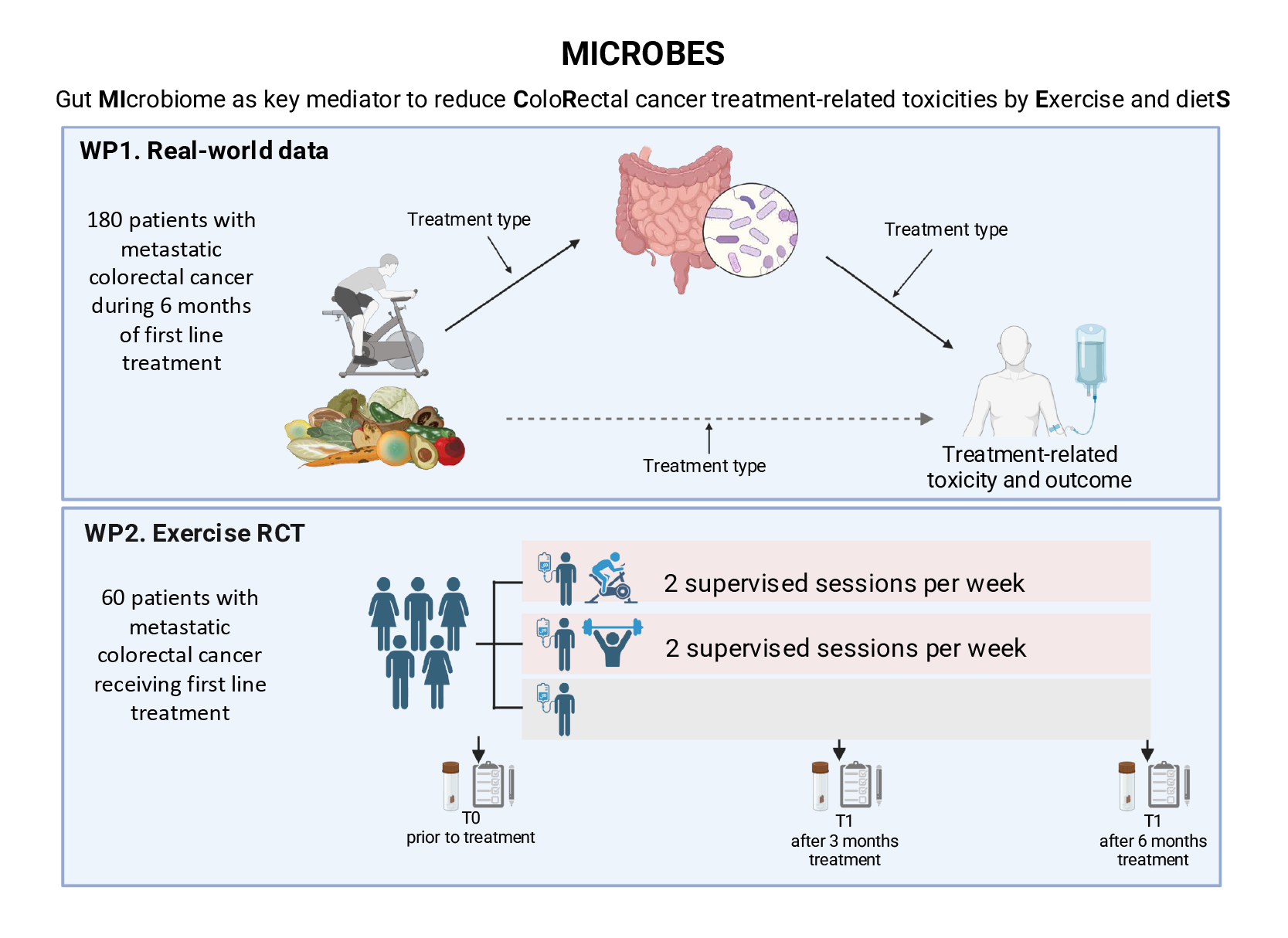 Graphical abstract provided by Dr Laurien Buffart
Background
Patients with stage 4 bowel cancer often receive chemotherapy, and sometimes immunotherapy. These treatments can lead to severe side effects in the digestive system, such as diarrhoea, which may lead to adjustments in treatment or even complete discontinuation. These treatment changes can affect patients’ survival time. Studies show that a higher level of physical activity and a healthy diet may reduce side effects, resulting in fewer treatment adjustments and better survival. However, how these lifestyle factors are linked to clinical benefits is not fully understood.
The microbiome, which is the community of micro-organisms present in the bowel, may play a connecting role. Treatment can lead to a less diverse microbiome, which has been linked to increased side effects. In turn, physical activity and healthy diets may support the healthy bacteria in the gut, resulting in a diverse microbiome and potentially fewer side effects and improved response to treatment.
Aims and objectives
We aim to study whether habitual higher physical activity levels and a healthy diet are associated with greater microbiome diversity, and whether this links with fewer side effects and better treatment response in patients with stage 4 bowel cancer.
Our objectives are to:
- Assess the relationships between physical activity and diet with diversity of the gut microbiome and examine how this relates to treatment side effects and outcome in patients with stage 4 bowel cancer undergoing their first treatment of chemotherapy or immunotherapy.
- Explore whether the relationships between physical activity and diet, with the microbiome and treatment side effects, differ between chemotherapy and immunotherapy.
- Assess the effect of exercise during chemotherapy treatment on the gut microbiome composition in patients with stage 4 bowel cancer.
How it will be done
This four-year study consists of two parts:
Part 1: We will follow 180 newly diagnosed patients with stage 4 bowel cancer, who will be treated with chemotherapy (with or without targeted therapy) or immunotherapy. All patients will receive questionnaires about side effects, quality of life, physical activity and diet, and will be asked to provide stool samples at diagnosis and after three and six months of treatment, to analyse the changes in the gut microbiome during treatment. Clinical data, questionnaire data and microbiome samples will be combined to explore links between lifestyle, microbiome and side effects over time, and explore the outcomes.
Part 2: We will compare the changes in the gut microbiome between patients with stage 4 bowel cancer who received an exercise programme during chemotherapy and those who did not. These two groups will be determined randomly. Patients will be asked to provide stool samples when starting treatment and after three and six months of treatment, and will receive a short questionnaire on habitual diet.
Potential impact
Knowledge on whether physical activity and diet can improve gut health and reduce side effects in patients with stage 4 bowel cancer would strengthen the case for adding lifestyle support to cancer care, helping to improve quality of life and survival.
Scientific novelty
This study is the first to investigate how physical activity and diet affect gut health and how gut health influences treatment side effects and outcomes in patients with stage 4 bowel cancer. The findings of parts one and two combined will show how lifestyle habits can reduce treatment-related side effects and improve treatment results in real-life settings.