

Grant title: Diet-Induced Risk of Liver Metastasis
Institution: University of Liverpool
Grant awarded: September 2026
Funded by: World Cancer Research Fund
We are very grateful to World Cancer Research Fund for supporting this research into how increasingly common unhealthy, high-fat diets may make the liver more vulnerable to cancer metastasis. By understanding the underlying mechanisms, we hope to identify new ways to prevent cancer spread, develop better treatments and ultimately help patients live longer, healthier lives.Professor Michael Schmid
🔍 Click image to enlarge
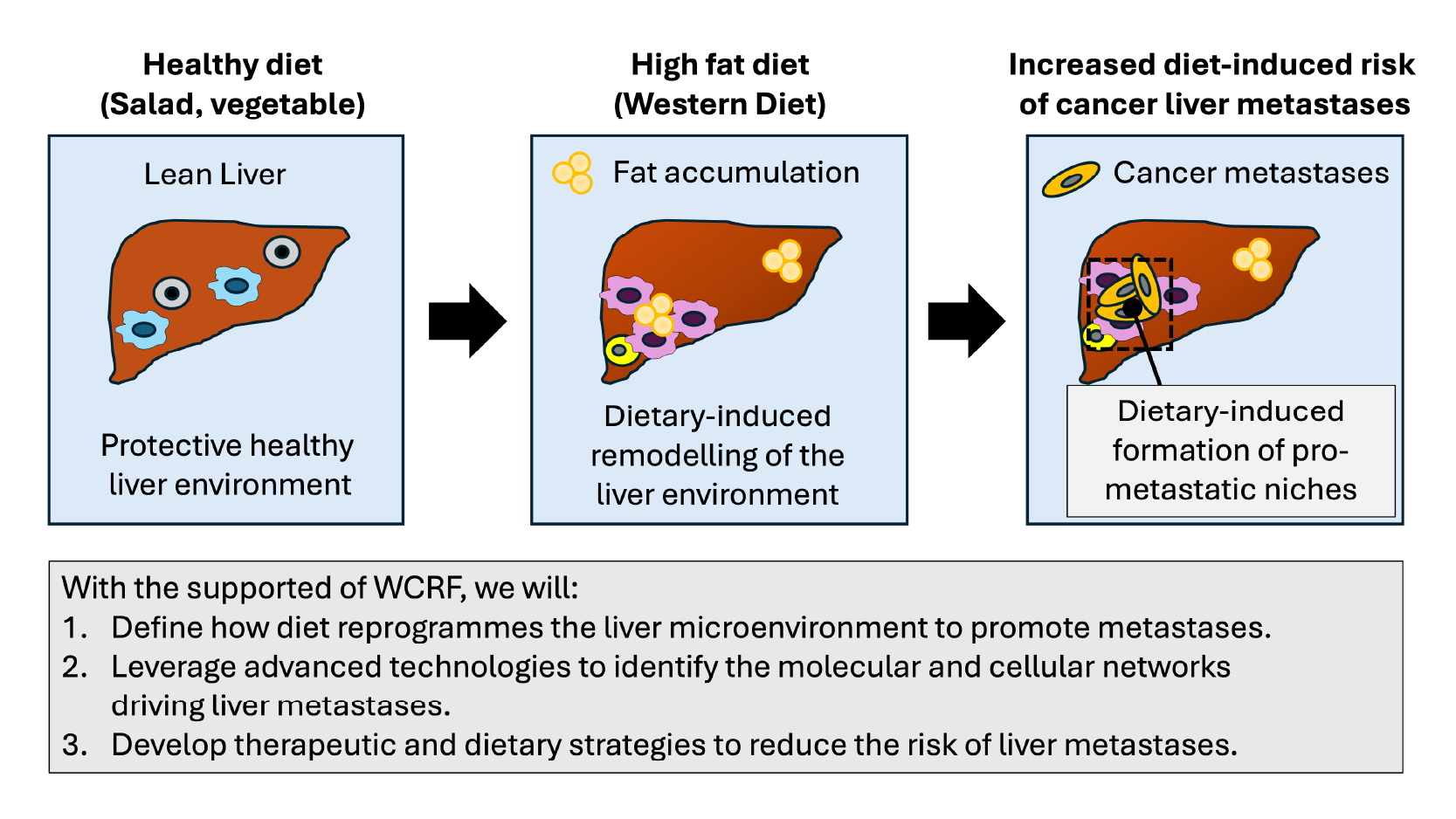 Graphical abstract provided by Professor Michael Schmid
Background
The spread of cancer cells to other organs, known as metastasis, accounts for approximately 90% of the 10 million cancer deaths worldwide each year. The liver is one of the most common sites of metastasis, making liver metastases a major clinical challenge. Once cancer spreads to the liver, treatment options are often limited and survival rates decline substantially. However, why some livers are more susceptible to cancer metastasis than others remains poorly understood.
The liver contains different types of specialised liver cells and immune cells, which work together to maintain liver function and regulate immune responses. Changes in this carefully balanced environment can influence whether cancer cells survive and grow after reaching the liver.
High-fat diets are increasingly common and contribute to the global rise in fatty liver disease, which affects approximately one in three people worldwide. Excess fat can alter liver cell function and disrupt immune responses, potentially creating conditions that favour cancer growth. Our early findings indicate that diet-induced changes make the liver more susceptible to cancer metastasis. Understanding how a high-fat diet increases the risk of liver metastases could reveal new opportunities to prevent cancer spread and improve patient outcomes.
Aims and objectives
This project will investigate how high-fat diets increase liver susceptibility to cancer metastasis by reprogramming the immune microenvironment.
Specifically, we will:
- Define how different types of high-fat diets reprogramme the liver microenvironment.
- Identify the molecular and cellular networks driving liver metastasis using advanced technologies.
- Develop therapeutic and dietary strategies to counteract diet-induced changes in the liver microenvironment and reduce the risk of liver metastasis.
How it will be done
We will combine laboratory experiments with studies of human liver samples. We will compare how different types of high-fat diets affect liver composition and determine whether these changes increase the development of liver metastases. We will examine liver immune cells to understand how excess dietary fat alters their behaviour and creates an environment that supports tumour growth.
We will then test interventions targeting specific immune cells or diet-related changes to determine whether the increased susceptibility to metastasis can be prevented or reversed. Finally, we will analyse liver samples from cancer patients to investigate whether similar immune and metabolic changes occur in humans.
Potential impact
This research will establish how high-fat diets influence the liver environment and contribute to an increased risk of cancer metastasis. By identifying the immune and metabolic changes responsible for making the liver more susceptible to tumour growth, the project could reveal new therapeutic targets. In the longer term, these findings may support the development of treatments and evidence-based dietary strategies to reduce liver metastases and improve outcomes for patients with cancer.
Scientific novelty
This project will investigate how dietary fat changes the liver’s immune environment to increase its susceptibility to cancer metastasis. By uncovering how high-fat diets alter liver immune cells and create conditions that favour tumour growth, the research could identify previously unrecognised links between diet, liver health and cancer spread. Testing whether these changes can be reversed through dietary or targeted interventions will help establish new approaches to reducing liver metastases, with potential relevance to several cancers that spread to the liver.