

Grant title: Impact of micro- and nanoplastics on immune regulation and predisposition to liver metastasis
Institution: University of Liverpool
Grant awarded: September 2026
Funded by: World Cancer Research Fund
I am grateful to receive this funding from World Cancer Research Fund, which will allow us to investigate an important and largely unexplored question: could exposure to micro- and nanoplastics influence how cancer spreads to the liver? By bringing together cancer biology, immunology, polymer chemistry and advanced spectroscopic analysis, we hope to generate findings that could ultimately benefit patients and inform future prevention strategies.Professor Dr Ainhoa Mielgo
🔍 Click image to enlarge
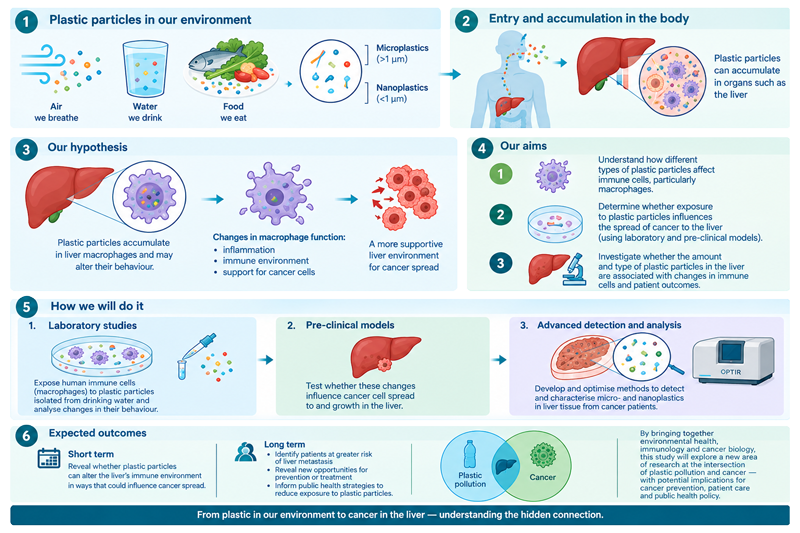 Graphical abstract provided by Professor Ainhoa Mielgo
Background
Tiny plastic particles, known as microplastics and nanoplastics, are increasingly found in our everyday environment, including the air we breathe, the water we drink and the food we eat. These particles can enter our bodies and may build up in organs such as the liver. Although the liver is essential for keeping us healthy, it is also the most common site to which many cancers spread. Once cancer has spread to the liver, it can be particularly difficult to treat. Yet we know very little about whether environmental exposures, such as plastic particles, could influence the liver’s vulnerability to cancer spread.
Together, pancreatic and bowel cancers cause more than 1.7 million deaths worldwide each year, highlighting the urgent need to better understand what makes the liver vulnerable to cancer and how we can protect it.
Aims and objectives
Our early results show that plastic particles can be found in the liver’s immune cells, called macrophages, and may change the way these cells work. We believe that this could make the liver more likely to attract and support the growth of cancer.
The goals of this study are:
- To understand how different types of plastic affect the way immune cells function.
- To test whether plastic exposure makes it easier for cancer to spread to the liver in laboratory models.
- To find out if the amount and type of plastic in the liver are linked to changes in immune cells and poorer survival in cancer patients.
How it will be done
We will carry out experiments with human immune cells in the laboratory, exposing them to tiny plastic particles isolated from drinking water and studying changes in their activity. We will use pre-clinical models to investigate whether plastics influence the spread of cancer to the liver. Finally, we will develop and optimise advanced methods for detecting and characterising micro- and nanoplastics in liver tissue from cancer patients.
Potential impact
In the short term, this project will reveal whether everyday exposure to plastics could make the liver more vulnerable to cancer. In the longer term, this research could lead to new ways of predicting which patients are at risk of liver cancer spread and help identify new treatment strategies. Beyond medicine, our results could also guide public health campaigns and policies to reduce harmful plastic exposure and promote safer, more sustainable use of plastics.
Scientific novelty
Although plastics are everywhere in our daily lives, almost nothing is known about how they affect cancer risk. This will be the first study to explore how plastic particles in the liver might change immune cells and increase the chance of cancer spreading, addressing an urgent and overlooked question with major health and environmental implications.
This project brings together two major and rapidly growing global health challenges: plastic pollution and cancer. While the health consequences of plastic exposure are receiving increasing attention, almost nothing is known about how plastic particles that reach human tissues might influence the progression of cancer. Conversely, cancer research has largely focused on genetic, tumour and immune factors that control metastasis, with much less attention given to environmental exposures that may shape the tissues in which cancer spreads. By bringing together environmental health, immunology and cancer biology, this study will investigate whether an everyday environmental exposure can reshape the immune environment of the liver and influence its ability to support cancer spread. Understanding this previously overlooked connection could open a new area of research at the intersection of plastic pollution and cancer, with potential implications for cancer prevention, patient care and public health policy.