

Grant title: Hidden Risk in Every Glass: The Cancer Toll of Nitrate in Water
Institution: Danish Cancer Society Research Centre
Grant awarded: September 2026
Funded by: Wereld Kanker Onderzoek Fonds
We are delighted and grateful to receive this support from Wereld Kanker Onderzoek Fonds (WKOF). Our previous WKOF-funded research revealed that the source of nitrate and nitrite matters and provided evidence linking drinking water nitrate to a higher risk of colorectal cancer. This new grant gives us a unique opportunity to build on those findings by further investigating cancer associations and the underlying biological mechanisms, with the ultimate goal of generating evidence that can inform both cancer prevention and public health policy.Professor Anne Tjønneland
🔍 Click image to enlarge
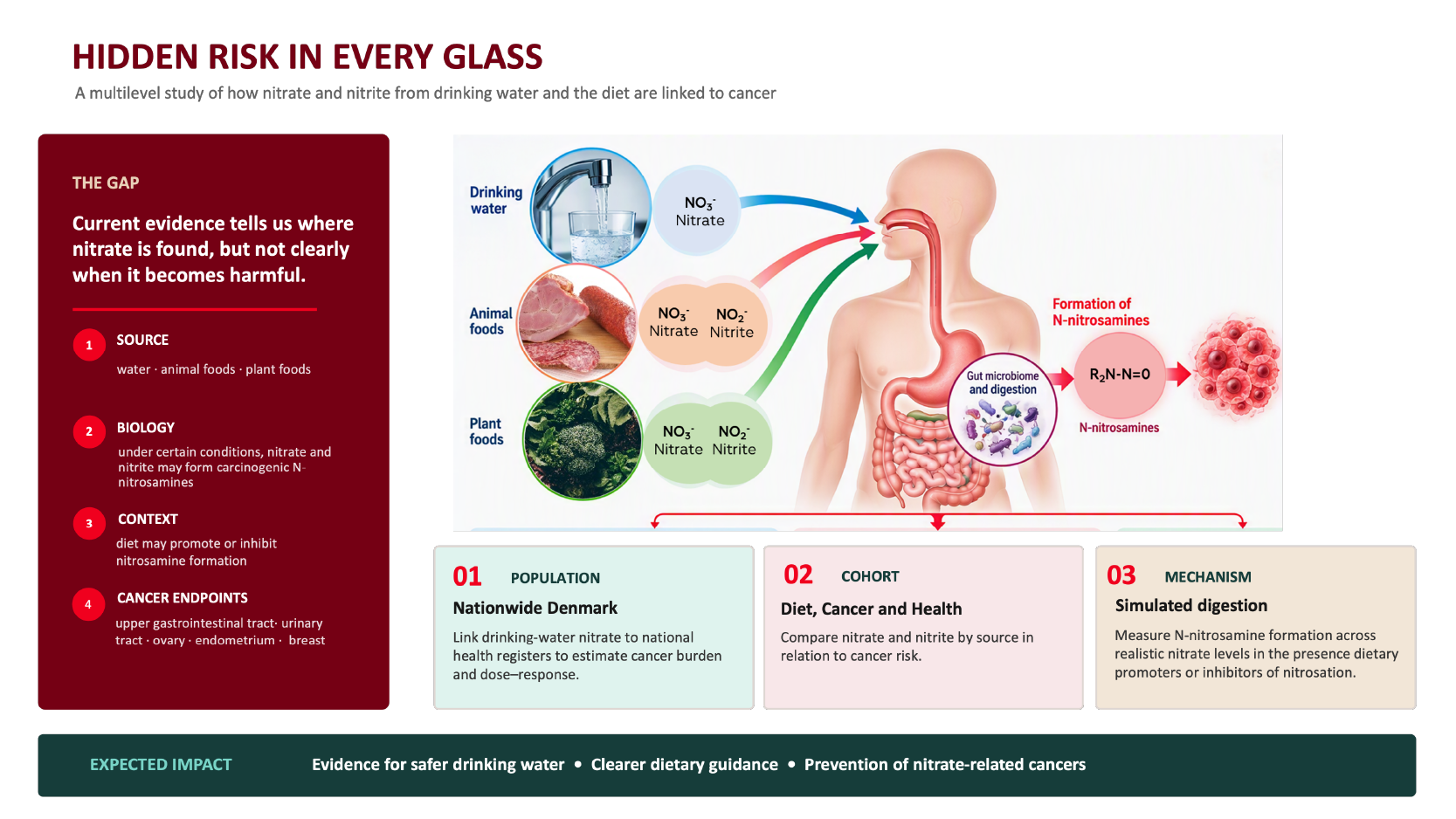
Graphical abstract provided by Professor Anne Tjønneland
Background
Nitrate is one of the most common contaminants in drinking water worldwide, getting into groundwater mainly from agricultural fertilisers and animal waste. Once inside the body, nitrate can be converted into compounds called N-nitrosamines, some of which cause cancer.
Our previous research, funded by Wereld Kanker Onderzoek Fonds, showed that people exposed to higher levels of nitrate in drinking water are more likely to develop bowel cancer, and we found that health effects depend on the source: nitrate from water and processed meat increases cancer risk, while nitrate from vegetables appears to lower cancer risk. Based on this evidence, in December 2025 an international expert committee recommended reducing Denmark’s drinking water nitrate limit from 50 mg/L to 6 mg/L. However, the evidence for other cancers (stomach, kidney, bladder, breast, ovary, uterus) remains insufficient. Furthermore, upgrading water treatment infrastructure will take many years, creating an urgent need for dietary strategies that can reduce cancer risk immediately.
Aims and objectives
This project aims to close these gaps in the evidence. We will investigate whether drinking water nitrate increases cancer risk at concentrations currently considered safe, whether effects differ depending on nitrate source (water, processed meat, or vegetables), and whether dietary factors can reduce or increase risk. Our key objectives are to:
- Examine relationships between drinking water nitrate and risks of stomach, oesophageal, urinary tract, breast, ovarian, and uterine cancers across the entire Danish population.
- Investigate whether cancer risks differ depending on nitrate source (water, processed meat, or plant foods) and whether dietary factors modify the risks from drinking water nitrate, using detailed dietary data from 54,610 Danes followed for 27 years.
- Experimentally test how nitrate converts to N-nitrosamines under conditions that mimic human digestion, and how specific foods (like red meat, cheese, and cured meat versus orange juice, tea, and spinach) affect this process.
How it will be done
We will use Denmark’s exceptional national data resources, which link information on where people have lived, drinking water nitrate measurements and health outcomes. This allows us to track nitrate exposure and cancer occurrence among all Danish adults aged 35 and older, from 1978 to 2023. We will also analyse detailed dietary information from a large health study to understand how different nitrate sources and dietary patterns affect cancer risk. In parallel, we will use laboratory models designed to mimic human digestion to investigate how N-nitrosamines form when nitrate is ingested at different concentrations, providing essential insight into real-world cancer risks.
Potential impact
Our findings will directly inform the ongoing revision of nitrate safety limits in Denmark and the European Union. They will also guide practical cancer-prevention advice through dietary strategies that can reduce the formation of N-nitrosamines. In the longer term, this research will help shape international drinking-water standards and could prevent thousands of cancer cases worldwide.
Scientific novelty
This is the first study to combine nationwide, highly detailed information on nitrate exposure with experimental research on biological mechanisms. By combining large-scale population studies and laboratory science, this project will provide the strongest evidence yet on how nitrate in drinking water may contribute to cancer, turning uncertainty into action for safer water and healthier lives.