

Grant title: Disrupting Sedentary Behavior using Physical Activity Snacks in Older Post-treatment Breast Cancer Survivors
Institution: The University of Alabama at Birmingham
Grant awarded: September 2026
Funded by: American Institute for Cancer Research
“Words cannot express our gratitude to the American Institute for Cancer Research for supporting our efforts to promote physical activity among older breast cancer survivors. Many older survivors spend much of their day sitting, which can negatively affect their health, mobility, and independence. This funding provides an exciting opportunity to test a home-based intervention using ‘physical activity snacks’ (brief 2-5-minute bouts of movement performed multiple times throughout the day) to help older survivors move more and sit less.”
Dr Nashira Brown
🔍 Click image to enlarge
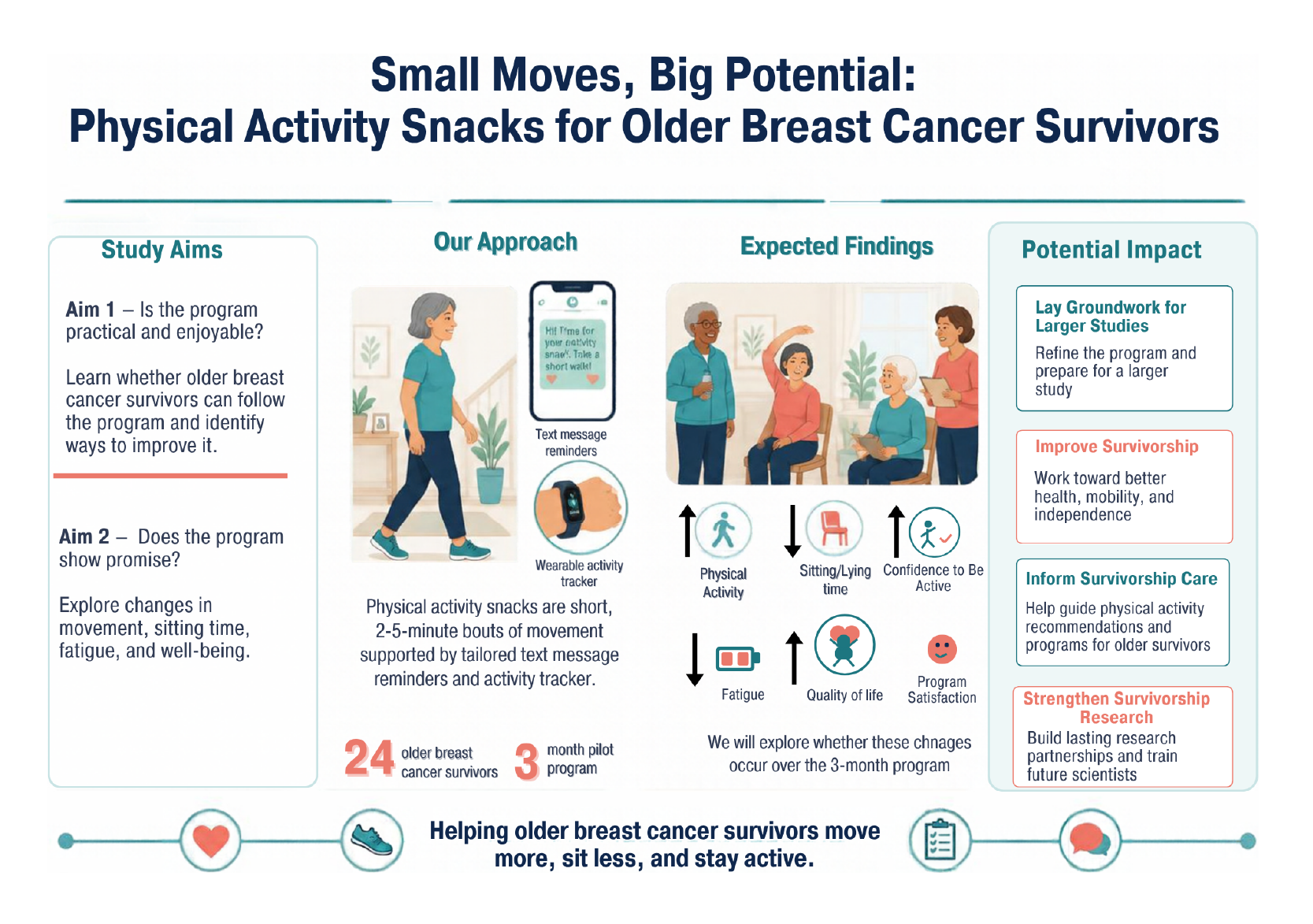
Graphical abstract provided by Dr Nashira Brown
Background
Many older people living with breast cancer (aged 65+) spend much of their day sitting, which can negatively affect their health, mobility, and independence. “Physical activity snacks” – short bursts of movement lasting less than 10 minutes – may be a practical way to help this group move more and sit less. However, most existing programmes include activities like jogging and are delivered in person (in a research lab), making them difficult for this population to participate in.
Aims and objectives
The goal of this study is to help this group reduce the amount of time they are sitting and increase the number of minutes that they are active and moving. We will examine whether the programme is easy to follow, acceptable to participants, and helpful for increasing daily movement. The next step is to test the adapted programme to see how well older people living with cancer respond to it and to identify what should be improved before trying it in a larger study.
How it will be done
We have adapted physical activity snacks to better fit the needs, preferences, and challenges of older people living with cancer who currently sit more than 8 hours a day. The adapted programme includes brief activities such as walking and simple lifestyle movements lasting 2-5 minutes throughout the day, along with cancer-specific educational materials. As a part of the programme, they will receive text message reminders to encourage them to complete their physical activity snacks, as well as an activity tracking device to help them monitor their daily movement.
Potential impact
The results from this study would provide preliminary evidence that activity snacks are a manageable way for people living with cancer to incorporate physical activity into their day and improve their health. This could then be used to support future, large-scale studies that could then support changes to cancer patient and survivorship guidance.
Scientific novelty
This is the first study to test physical activity snacks in a group of people living with cancer. It also uses a more dynamic method of assessment, compared to historical studies.