

Grant title: From Diet to Damage: Linking Metaflammation, Transcription Stress, and Colon Cancer
Institution: Erasmus Medical Center
Grant awarded: September 2026
Funded by: Wereld Kanker Onderzoek Fonds
Colorectal cancer is one of the most common malignancies worldwide, and its incidence is increasing, especially among young adults. While we know that the main factors predisposing to colorectal cancer are pro-inflammatory and often associated with specific unhealthy lifestyles, including Western-style dietary habits, the mechanisms underlying tumour onset in the context of inflammation driven by specific environmental risk factors are still largely unknown. Through this project, we will investigate how unhealthy dietary habits affect the cells of the intestine and increase disease risk.
By identifying the first warning signs and understanding the processes that take place before cancer develops, we hope to contribute to better prevention strategies, earlier diagnosis, and more personalised treatments. The support provided by Wereld Kanker Onderzoek Fonds will contribute to our research on this relevant and growing public health challenge.Professor Riccardo Fodde
🔍 Click image to enlarge
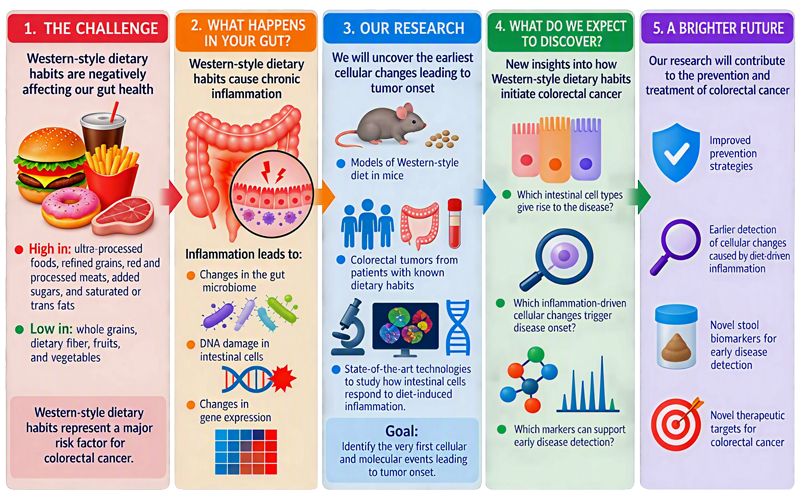 Graphical abstract provided by Professor Riccardo Fodde
Background
Colon cancer is one of the most common cancers among Western societies and, while mainly occurring in older individuals and as such being preventable by population screening programmes, its rates are still rising, especially among younger adults. Western-style diets, high in processed foods, sugars, and unhealthy fats, represent the main colon cancer risk factor. Recently, it has been established that the Western-style diet causes a mild but chronic inflammation of the digestive tract. Over time, this may damage intestinal cells and increase cancer risk.
A well-established principle in cancer biology predicts that most cancers arise from stem cells. However, a recent study from our laboratory suggests that colon cancer, in the context of inflammation caused by diet, is initiated in specialised cell types that, in response to the tissue damage, modify their identity to gain stem cell’s characteristics. When initiated in these specialised cells and in the context of inflammation, colon cancer progresses to more aggressive forms with poor overall survival.
Aims and objectives
This project aims to explain how unhealthy diets cause stress in colon cells and how this cellular stress might lead to cancer onset. Specifically, we want to find out:
- Which types of cells are most affected by diet-related inflammation.
- How stress in these cells leads to DNA damage and changes in their behaviour.
- Whether early warning signs of these changes can be detected in individuals with Western-style dietary habits.
By pursuing these objectives, we hope to uncover new ways to identify individuals at risk and explore better strategies to prevent and even cure colon cancer.
How it will be done
We will use advanced tools and techniques in both laboratory models and patient-derived samples. We will feed a Western-style diet to mouse models genetically modified to monitor different intestinal cell types in response to inflammation. We will determine how these cells change over time as a function of cellular damage and stress. We will also study colon cancers from patients with Western-style dietary habits. Finally, we will integrate the results from the mouse models and clinical material to identify markers to predict which individuals are at risk.
Potential impact
In the short term, this research will help us to understand how diet affects healthy cells and increases the risk of cancer. It will reveal new biological “flags” that signal when cells are under stress and at risk of becoming cancerous. In the long term, the findings could lead to new ways of classifying colon cancer based on how and where it starts. This could improve early detection, especially for younger people who are not routinely screened. It could also guide future treatments that target the specific cell types and processes involved in diet-related cancer.
Scientific novelty
What makes this study unique is its focus on how fully “developed” colon cells, not just stem cells, can become cancerous under dietary stress. By linking diet, inflammation, and cell behaviour, we are opening the door to a new understanding of colon cancer that could lead to more personalised preventive and therapeutic approaches.