

Grant title: Can intermittent fasting reduce bowel cancer risk?
Institution: La Trobe University
Grant awarded: September 2026
Funded by: World Cancer Research Fund
Finding ways to stop bowel cancer before it starts is vital. This project will help us understand whether intermittent fasting could protect the bowel and offer new possibilities for prevention. We’re grateful to the World Cancer Research Fund for making this research possible.Professor Erinna Lee
🔍 Click image to enlarge
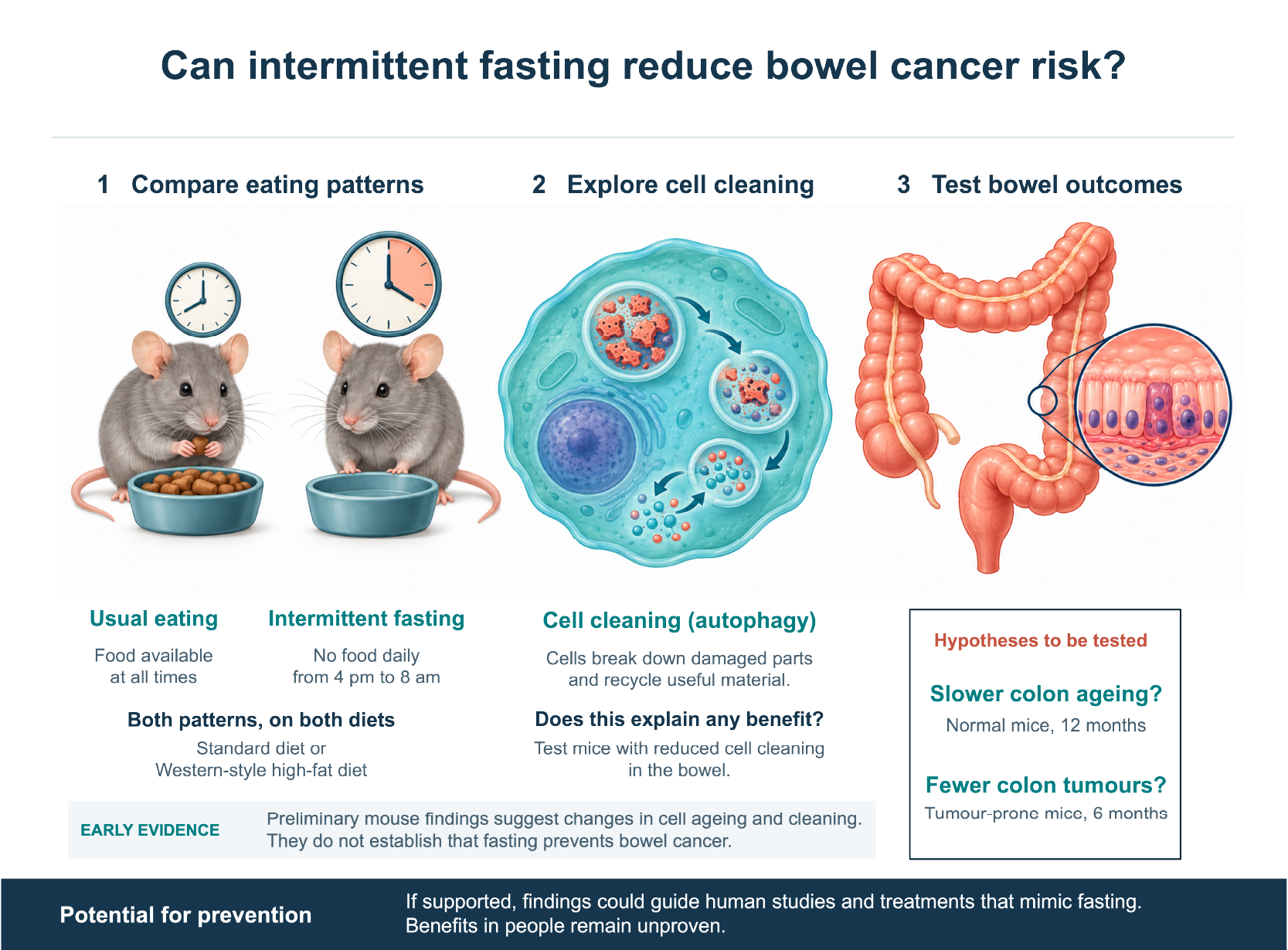 Graphical abstract provided by Professor Erinna Lee
Background
Bowel cancer kills over 900,000 people around the world each year, many of them in the prime of their lives. We know that getting older, our genes, our diet, and conditions like obesity all increase the risk of getting bowel cancer. Finding ways to prevent this disease is extremely important.
What is intermittent fasting? Intermittent fasting means alternating between periods when you don’t eat and periods when you can eat normally, without changing what you eat – just when you eat it. Studies in animals and people have shown that intermittent fasting can help with weight loss, help organs stay healthier as we age, and even help some organisms live longer.
When we fast, our cells activate a “cleaning” process called autophagy that removes damaged parts and recycles useful material. We think that intermittent fasting will cause similar beneficial changes in the cells lining the colon (the main part of the large bowel), which might reduce the risk of colon tumours developing.
Aims and objectives
We will study normal mice and mice that have been genetically modified to be prone to developing colon tumours to:
- Determine the impact of intermittent fasting on ageing in the colon of normal mice, and whether this is controlled by autophagy.
- Determine the impact of intermittent fasting on colon tumour development in mice and the role of autophagy in controlling this process.
- Test this in mice eating either a normal diet or a Western-style high-fat diet (like many people eat today).
How it will be done
Normal mice will be fed either a standard diet or a Western-style diet, with food available at all times or with intermittent fasting (no food from 4pm to 8am daily), for 12 months. The impact of intermittent fasting on the bowel will be assessed. Mice which have been genetically modified to develop colon tumours more easily, will be fed the same as the normal mice and the impact of intermittent fasting on the number of colon tumours will be determined six months after the diets begin. The role of autophagy, in any preventative effects of intermittent fasting, will also be assessed.
Potential impact
In the short term we’ll learn whether intermittent fasting can help slow age-related changes in the cells that line the colon and whether it reduces colon tumour development in mice. We will also learn whether any benefits occur even in mice eating a Western-style high-fat diet. Finally, we will learn whether the cell-cleaning process of autophagy is central to any benefits.
If we demonstrate that intermittent fasting can slow age-related changes in the normal bowel and reduce colon tumour development in mice, we can design short term intervention studies to test its effects on bowel health and markers of colon tumour risk in humans. If these studies are successful, they will provide the evidence needed for longer term intervention studies, including in high-risk patient groups.
Scientific novelty
This detailed study will investigate how intermittent fasting affects colon tumour development and will help us understand the biological mechanisms behind any protective effects. If successful, this could lead to new ways to prevent cancer, either through dietary changes or through medicines that provide similar benefits without the need to fast.