
A new way to define obesity

Is there a better way to classify obesity than relying on BMI alone?
Body mass index (BMI) is a simple calculation: take a person’s weight, divide it by their height squared and you get an idea of their body size.
While it’s easy to use, it may not be capturing the whole picture when it comes to obesity. That’s the question Dr Heinz Freising at the International Agency for Research on Cancer (IARC), together with colleagues Dr Michael Stein and Prof Michael Leitzmann, have been looking into.
We sat down with Dr Freisling to discuss their research letter, which evaluates the association between a new definition of obesity, proposed by the Lancet Diabetes and Endocrinology Commission, and mortality in the UK Biobank.
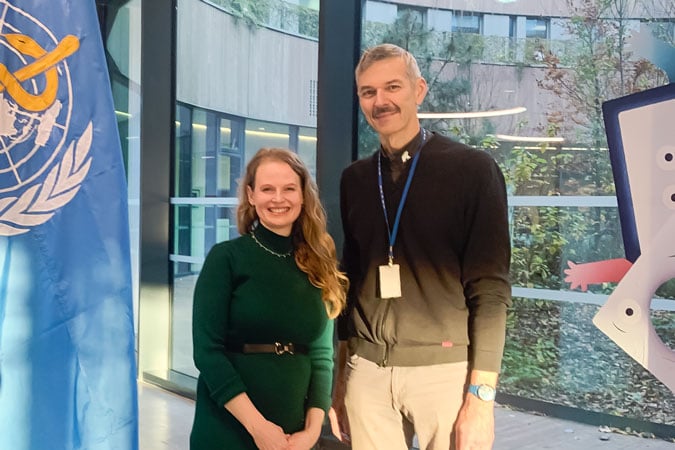
Dr Heinz Freisling with Dr Jana Sremanakova, Research Funding Manager, WCRF International
How would you explain what is new about this definition of obesity?
The new definition of obesity distinguishes clinical obesity from preclinical obesity. The difference is whether there are clear health problems caused by obesity.
– Clinical obesity means obesity is already causing health issues that are directly linked to obesity, like any or more of the following:
- Trouble breathing (eg breathlessness and/or wheezing)
- High blood pressure
- Joint problems (eg osteoarthritis)
- Elevated blood glucose levels in conjunction with high triglycerides and low HDL cholesterol levels.
- Problems with other organs including the central nervous system, liver or cardiovascular
– Preclinical obesity means someone has excess body fat but no obvious health problems yet. They’re healthy for now, but the risk of obesity-related health issues in the future is real.
This new definition acknowledges that you can have extra body fat and still be healthy, at least for a while.
This new assessment of excess body fat doesn’t just rely on BMI – it’s alsoconfirmed by additional measurements of body size such as; waist circumference, waist-to-hip ratio and waist-to-height ratio. These health measurements can be used together with BMI or independently to assess overall body fat.
Alternatively, precise clinical tools to measure body fat should be used, such as a specialised X-ray scan (DEXA) or a body composition scale (Bioimpedance measurement).
What is the most common misunderstanding about obesity and health that your study helps to correct for the general public?
Obesity is often portrayed as the result of unhealthy eating or insufficient willpower. This view fuels stigma toward people living with obesity. In reality, obesity is a complex chronic condition shaped by a variety of factors, such as:
- Genetics
- Socioeconomic position
- Environment
- Long-term physiological adaptations.
As excess body fat builds up, the body’s system for managing energy, nutrients and metabolism begins to change. Cutting calories – as often happens during dieting – doesn’t necessarily lead to proportional fat loss because the body adapts to defend its own weight.
New medical guidelines have recently redefined obesity as a disease caused by physical changes in the body, rather than a matter of personal behaviour or lifestyle choice. The aim is to reduce stigma and improve care by focusing on measurable health problems — not just a number on a scale.
While BMI remains the most widely used measure of body size in population research, it doesn’t tell the whole story. It can’t reveal where fat is distributed in the body, or whether excess fat is affecting how organs function. The new framework combines several body measurements with an assessment of organ health to give a fuller picture of how obesity affects a person overall.
If health systems were to adopt this approach, how might it change diagnosis or treatment in practice?
If health systems adopt this approach, it would make diagnosis more precise and reduce unnecessary treatments. Any treatment would become more personalised, targeting specific organ damage or functional impairment, much like how we treat other chronic diseases.
Do you see this as the start of a broader international shift?
I think we may see a gradual change over several years, driven by evidence, practicality, and available resources. Expert groups and professional societies worldwide are increasingly recognising the limitations of BMI and placing greater emphasis on biological changes, organ-specific effects, and how well a person is able to function day-to-day – as better indicators of when excess body fat becomes a true medical condition.
This fits with a wider movement in medicine toward precision and personalisation and helps reduce stigma by focusing on measurable health impact rather than body size alone. As more research accumulates and more organisations engage with this framework, the momentum behind such an approach is likely to continue building.
How did WCRF funding support this research and make a difference to the study?
Dr Freisling: WCRF funding enabled me to connect and kick-start a collaboration with like-minded researchers with complementary expertise to conduct this study.
Dr Stein: WCRF funding laid the foundation for me to pursue my PhD in the field of cancer epidemiology.
Prof Leitzmann: WCRF funding made this work possible by providing the resources and environment that allowed the research to reach a high scientific impact.
Dr Heinz Freisling, Dr Michael Stein and Prof Michael Leitzmann.
This research was conducted as part of Prof Leitzmann’s grant – Physical activity, sedentary behaviour and cancer risk in people with comorbidities.