

Grant title: Using ecological momentary assessment to identify personalised diet-bowel dysfunction triggers in colorectal cancer survivors: a real-time monitoring study
Institution: University of Leeds
Grant awarded: September 2026
Funded by: World Cancer Research Fund
“Ongoing gut problems are one of the most common and distressing challenges after bowel cancer, but there is very little evidence to guide people on what to eat. I’m very grateful to World Cancer Research Fund for funding this work, which will test a new way of tracking diet and symptoms in real time.”
Dr Sarah Jing Guo
🔍 Click image to enlarge
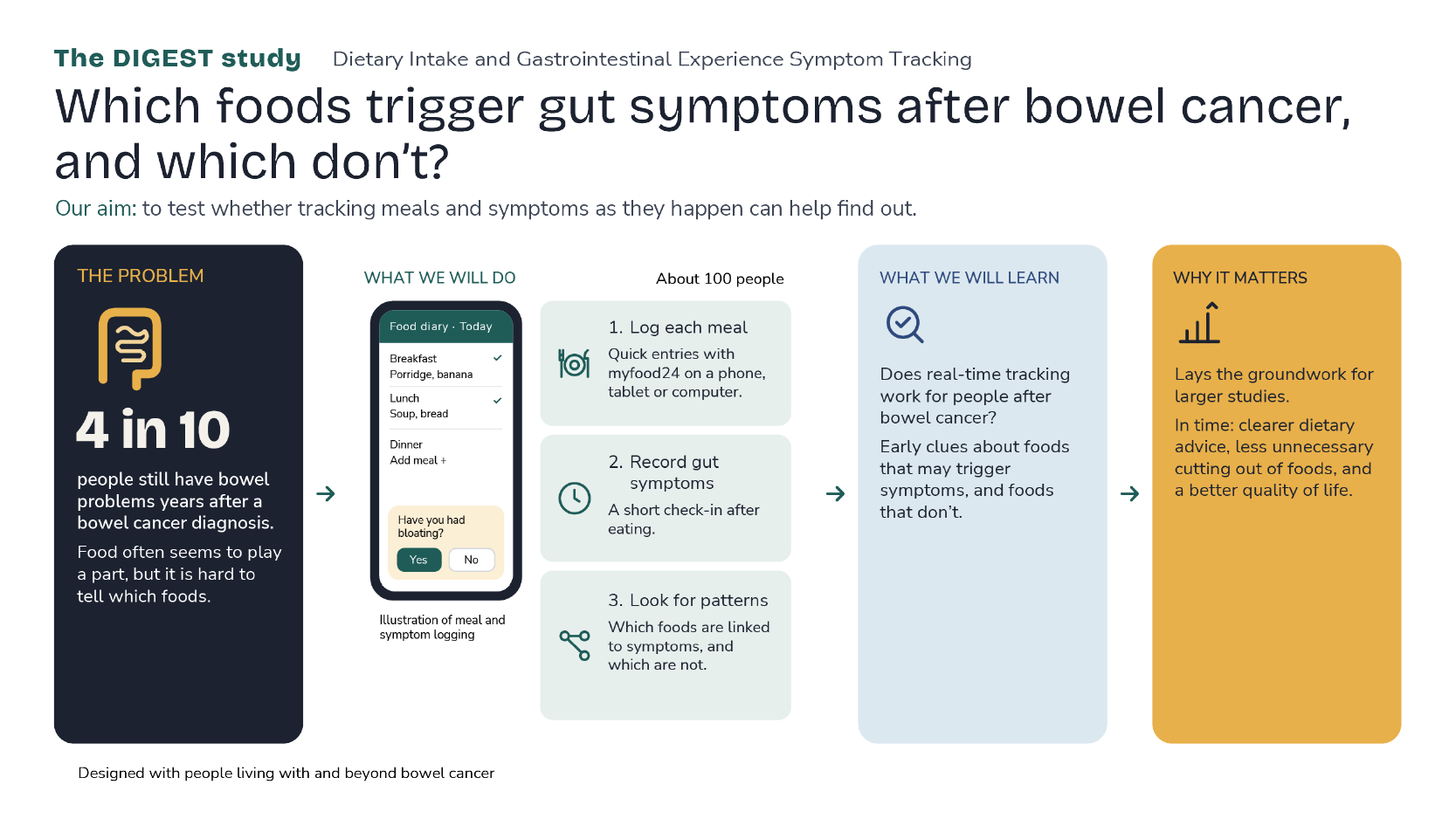
Graphical abstract provided by Dr Sarah Jing Guo
Background
Many people living beyond bowel cancer continue to experience daily digestive difficulties, such as diarrhoea, constipation, or painful bloating. These symptoms can be deeply distressing and often unpredictable, leaving people feeling as though life has not fully returned to normal even after treatment ends. Many notice that certain foods seem to worsen their symptoms, but because these problems can appear hours after eating, it is difficult to identify the exact causes. This uncertainty makes it challenging to manage eating habits with confidence. At present, the dietary advice available is usually quite general, meaning that many individuals still feel unsupported in managing their long-term gut health after a bowel cancer diagnosis.
Aims and objectives
We think the best way to understand which foods trigger gut problems is to record eating and symptoms as they happen. Our aim is to test a user-friendly smartphone tool that helps people track meals and gut changes in real time. We want to see whether this method can reveal personal food triggers more accurately, and whether using this tool is helpful and easy for people living beyond bowel cancer.
How it will be done
We will invite people who are within five years of a bowel cancer diagnosis to take part in a one-week tracking study using simple online data collection through smartphones.
Meal recording will be done using an online food diary called myfood24. Participants will quickly log what they eat and drink at different times of day. We have made this as easy as possible by asking them to only record ‘what’ they ate, without the need for complex weighing or measuring. We will use an approach that will prompt participants to record what they ate at specific meal or snack times, minimising the burden of recording a whole day at once and allowing for clearer linkage with symptom tracking.
Symptom tracking will be done after recording meals using a symptom record linked to myfood24. Participants will be prompted within two hours of eating to record their meal and any symptoms. Based on how the bowel works and the nature of post bowel cancer treatment changes, the periods when symptoms are most severe are likely to be within one to two hours after eating (especially breakfast and the evening meal). By matching the exact timing of meals with the timing of symptoms, we can create a ‘personal map’ of triggers for each participant.
Potential impact
In the short term, this project will show whether simple digital tools can help people living beyond bowel cancer to better understand gut symptoms. In the long term, we hope this will lead to a personalised food-and-symptom guide that gives each person clear evidence about their own triggers. This could help people eat with more confidence and improve their overall quality of life.
Scientific novelty
This study is unique because it focuses on each person’s real-time experiences. It is the first study to ask people living beyond bowel cancer to record both their diet and their gut symptoms as they happen. This gives a far more accurate and personal picture of how food affects their health than traditional surveys can provide.