

Grant title: Daily Step Count as a Novel Digital Biomarker for Health Outcomes in Cancer Survivors
Institution: Dana-Farber Cancer Institute
Grant awarded: September 2026
Funded by: American Institute for Cancer Research
“Daily step count measured by wearable devices provides a simple, objective way to capture everyday movement in real-world settings, moving beyond questionnaires to better understand how physical activity influences health outcomes in cancer survivors. With generous support from the American Institute for Cancer Research, we will leverage over half a million daily step count records from the Breast Cancer Weight Loss (BWEL) trial to develop an open-source data-processing and analytics pipeline and evaluate its real-world application in our clinical exercise programme at Dana-Farber Cancer Institute. Our ultimate goal is to translate everyday step counts into actionable insights that can guide personalised survivorship care and improve quality of life and long-term survival.”
Dr Chao Cao
🔍 Click image to enlarge
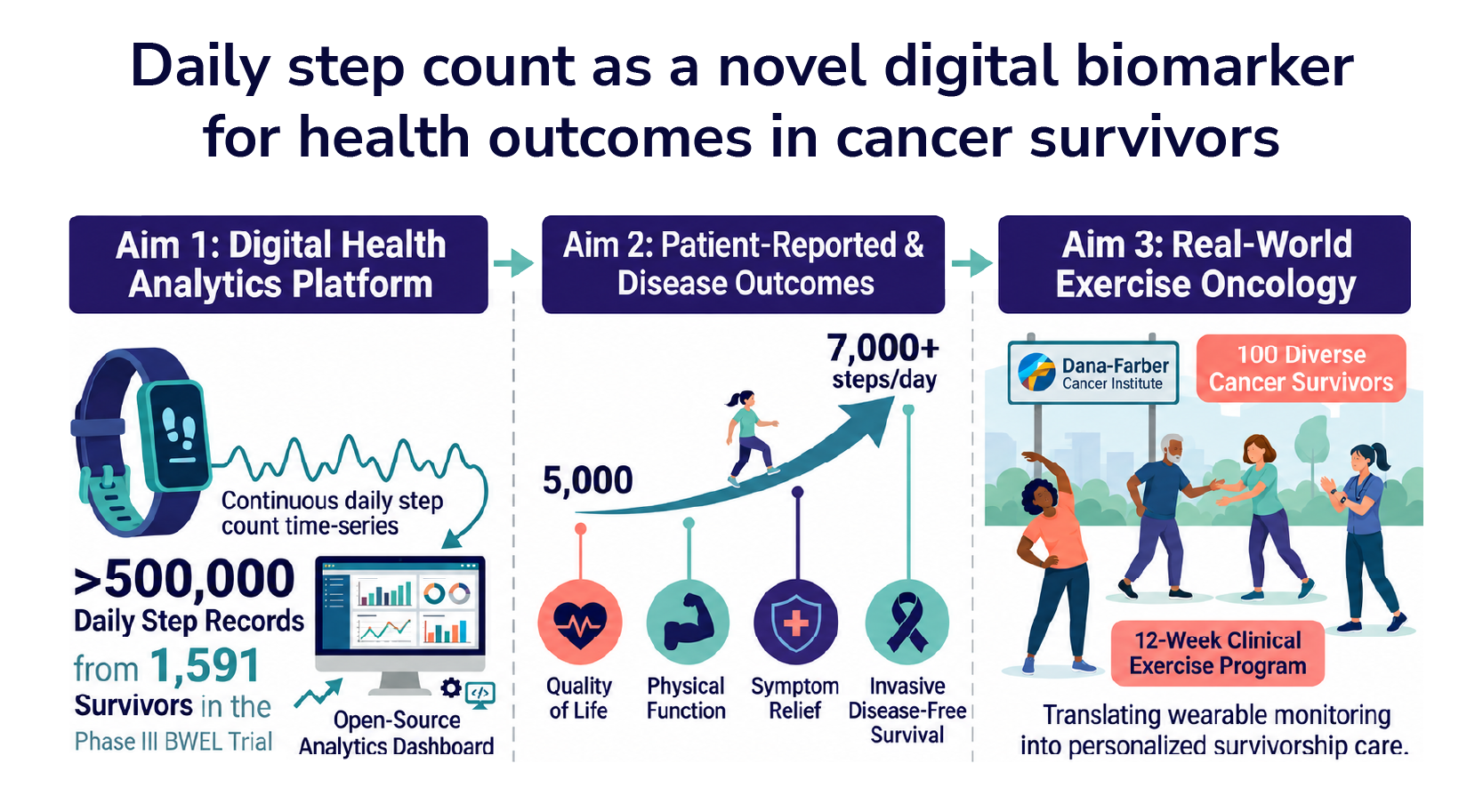
Graphical abstract provided by Dr Chao Cao
Background
The population of people living with and beyond cancer is growing. Many of these people can benefit from being physically active, including improvements in physical function, quality of life, and possibly long-term survival outcomes. However, most previous studies have relied on questionnaires that ask people to remember how active they were. These methods are often imprecise and do not show how activity changes over time in daily life. Wearable devices, such as activity trackers, now make it possible to measure movement continuously and objectively. Daily step count is one of the simplest and most familiar measures from wearable devices, but it is still not known whether changes in daily step count over time can help predict health outcomes in people living with cancer.
Aims and objectives
We hypothesise that daily step count measured by wearable devices can serve as a practical and useful marker of health in people living with cancer. This study aims to develop a new data analysis tool to record step counts from fitness trackers and test whether daily step count is linked with health outcomes in people who have experienced breast cancer. This will also collect new wearable data from a broader group of people living with and beyond cancer, taking part in an exercise programme.
How it will be done
The first part of the study will use data from a large weight loss trial in breast cancer in which participants used activity trackers over two years. These data include more than 500,000 daily step count records. We will use these records to build an open-source data platform and study how changes in step count over time relate to quality of life, symptoms and cancer outcomes. The second part of the study will recruit about 100 people living with cancer taking part in a 12-week exercise programme at Dana-Farber Cancer Institute. Participants will use wearable devices and their step counts will be compared with changes in physical function and self-reported health before and after the programme.
Potential impact
In the short term, this study will produce a new open-source tool, new evidence on step count and cancer health outcomes, and early wearable data from a real-world exercise programme. In the longer term, the findings may help doctors, exercise specialists, and people living with cancer to use daily step count as a simple way to track progress, guide exercise support, and improve survivorship care. This work may also help inform future physical activity recommendations for people living with and beyond cancer.
Scientific novelty
This study is novel because it moves beyond one-time questionnaires and instead uses wearable devices to measure activity continuously in real life. It also combines data from a large clinical trial with a real-world exercise programme and will create a freely available tool for researchers, clinicians and the public.