Polling
To understand how health misinformation is shaping cancer-prevention decisions, we commissioned YouGov research exploring what people believe, who they trust and the challenges misinformation creates for both the public and NHS professionals.

We wanted to understand how health misinformation is affecting people’s cancer-prevention choices, and the pressure it creates for healthcare professionals.
So, we partnered with YouGov to explore what people believe, who they trust and how misinformation is showing up in NHS conversations.
Health information is everywhere. From social media posts and influencer videos to product packaging, supplement adverts and newspaper headlines, people are exposed to a constant stream of advice about what to eat, what to avoid and what might protect their health.
Some of that information is helpful. But some of it is exaggerated, oversimplified or taken out of context. When that happens, it can become harder for people to know what to trust – especially when claims are presented confidently, shared by someone familiar, or linked to products promising quick results.
- Understanding the scale
- How the research was conducted
- Key findings
- What the findings tell us
- What you can do
Understanding the scale
For Cancer Prevention Action Week 2026, we commissioned YouGov to help us better understand the scale and impact of health and nutrition misinformation in the UK.
We wanted to explore:
- what the public understand about diet, nutrition and cancer prevention
- where people go for health and nutrition information
- which sources they trust
- whether people who rely more heavily on social media are more likely to believe unsupported claims
- what healthcare professionals are seeing in practice
- how confident NHS staff feel about finding reliable, evidence-based information themselves.
How the research was conducted
YouGov conducted two quantitative surveys.
The first surveyed 2,125 UK adults between 29 January and 9 February 2026. The figures were weighted to be representative of all UK adults by age, gender, region, social grade, education level and ethnicity.
The second surveyed 1,043 adults working in the NHS between 4 and 19 February 2026. The figures were weighted to be representative of NHS staff by occupational group.
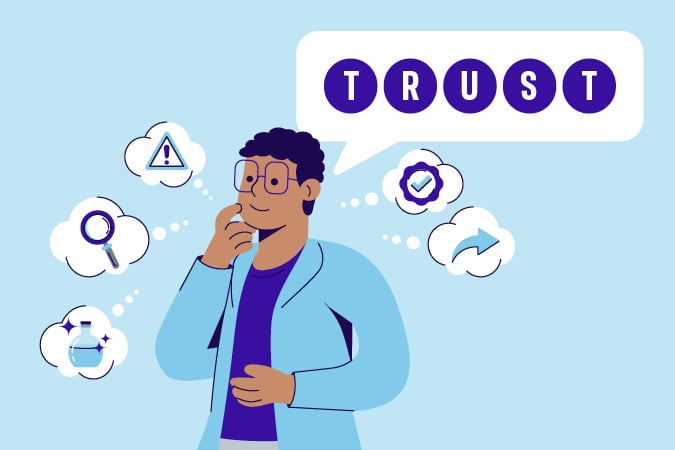
YouGov also conducted qualitative research through an online community, including members of the public and healthcare professionals. This explored how people encounter and interpret online nutrition information, what makes them trust or dismiss claims, and how campaign materials – including our TRUST Test – could help people make sense of what they see.
Key findings
The results confirmed something we already hear from healthcare professionals, patients and the public: many people are trying to make good decisions about their health, but they are doing so in an information environment that can feel confusing, noisy and difficult to navigate.
Key findings include:
- 44% of patient-facing NHS staff say patients raise inaccurate or misleading information about nutrition or supplements at least once a week.
- This includes 6% who say it happens daily or almost daily.
- 62% of UK adults say they feel confident they can find trustworthy nutrition information online.
- This rises to 72% among people whose main source of news is social network websites.
The social media effect
The findings also point to a confidence gap online. People whose main source of news is social media are less likely to identify eating plenty of fibre as something that can reduce cancer risk, and more likely to believe unsupported claims, including that certain supplements can reduce cancer risk or that certain foods or diets can “starve” cancer.
Everyday misunderstandings
Some of the clearest gaps relate to everyday cancer-prevention messages:
- Only 54% of UK adults identify eating plenty of fibre as something that can reduce cancer risk, meaning nearly half – around 46% – do not.
- More than 1 in 10 UK adults wrongly believe taking certain supplements can reduce cancer risk.
- 1 in 5 say detoxes or “cleanses” are good for health.
- More than 1 in 5 UK adults spend over £10 a month on dietary supplements.
- Around 7% spend more than £25 a month on supplements.
Supplements may be appropriate for some people in specific circumstances, but World Cancer Research Fund recommends not relying on dietary supplements for cancer prevention. For most people, the priority should be meeting nutritional needs through a healthy, balanced diet.
The NHS challenge
The survey of NHS staff also highlighted where support is needed. NHS staff were least confident about where to find reliable, evidence-based information on supplements and cancer prevention compared with nutrition more generally. This matters because healthcare professionals are often the people patients turn to when they are worried, confused or trying to make sense of claims they have seen online.
What the findings tell us
The polling is not about blaming people for being confused. It shows the opposite: people need clearer, more trustworthy information, and healthcare professionals need support to respond to the misinformation patients are bringing into conversations.
For the public, the message is to pause before acting on dramatic claims, be cautious of quick fixes, and look for evidence-based sources. For healthcare professionals, we want to provide practical resources that can help support patient conversations. And for policymakers, the findings underline the need for a healthier information environment and better support for prevention through the NHS Workforce Plan.
Cancer prevention should be grounded in evidence, not trends. During Cancer Prevention Action Week, we are helping people choose science, not fiction.
What you can do
Help people choose science, not fiction
Our research shows that clear, evidence-based information matters. Whether you’re a member of the public, healthcare professional or organisation, there are simple ways to support informed cancer-prevention decisions.
- Use the TRUST Test to sense-check health information before acting on or sharing it.
- Download the Campaign Toolkit to help spread evidence-based cancer prevention messages during Cancer Prevention Action Week.
- Share our campaign and help others choose science, not fiction.