New UK statistics from World Cancer Research Fund show a 3.7% rise in the total number of cancer cases diagnosed in women in 2021 compared with 2019, while cases in men remained relatively stable.
In the UK, 395,181 cases of cancer were diagnosed in 2021, the latest year for which data is available for all 4 devolved nations: 200,870 in men, and 194,311 in women. These figures were compiled using data from the 4 UK cancer registries and include the latest overall UK incidence, as well as information about cancer within each of the 4 devolved nations.
Cancer cases in men remained stable (increasing very slightly by 0.2% to 200,870 in 2021 from 200,386 in 2019), while among women there were approximately 6,800 more cases in 2021 than in 2019 (194,311 up from 187,434 in 2019) – an increase of 3.7%. This means that although men still experience more cases than women, the difference is rapidly narrowing. The difference in the number of cases falling from approximately 12,900 in 2019 to 6,500 in 2021.
Why are UK cancer cases rising in women but not men? Dr Vanessa Gordon-Dseagu explores the evidence
Find out moreAlthough the number of cases significantly increased among women but not men, this still meant an overall increase of 2%. There could be several reasons for this, for example, changes in behaviour that began decades ago. An example of this would be rates of smoking declining earlier in men than women, with lung cancer incidence subsequently peaking much earlier in men than women.
Behaviour and prevention key
This shows that behaviour and prevention remain a key factor in reducing cancer risk: 40% of cancers could be prevented through changes in modifiable risk factors and behaviours. These include eating a healthy diet, limiting alcohol, maintaining a healthy bodyweight, and not smoking. Therefore around 158,000 cancer cases in the UK could be prevented a year.
Breast cancer remains the most common type of cancer among women in the UK, and the most common overall, with 59,115 new cases in 2021. This means that 3 in 10 new cases of cancer in women in 2021 were breast cancer (30%). Meanwhile, prostate cancer is the most common cancer among men in the UK. In 2021, 51,575 cases of prostate cancer were diagnosed – accounting for just over a quarter (26%) of all new cases of cancer in men in the UK.
Dr Vanessa Gordon-Dseagu, a consultant with our Research Interpretation team, said:
“While the total number of cancers is still higher among men than women, the latest increases among women, and decreases among men, suggest that this difference is declining quite rapidly.
“It is likely that any changes in the number of new cases are partially explained by behaviour. This will be particularly true for those cancers for which there is strong evidence that behaviour increases risk. For example, smoking increasing lung cancer risk or processed meat and alcohol increasing bowel cancer risk. Following our Cancer Prevention Recommendations can help people reduce their cancer risk.”
About World Cancer Research Fund
World Cancer Research Fund examines how diet, nutrition, weight and physical activity affect people’s risks of developing and surviving cancer. As part of an international network of charities, we fund life-saving research, influence policy and raise public awareness. Our work helps prevent cancer and enables people to live longer, healthier lives.
Preventing Cancer. Saving Lives
Latest news and blogs
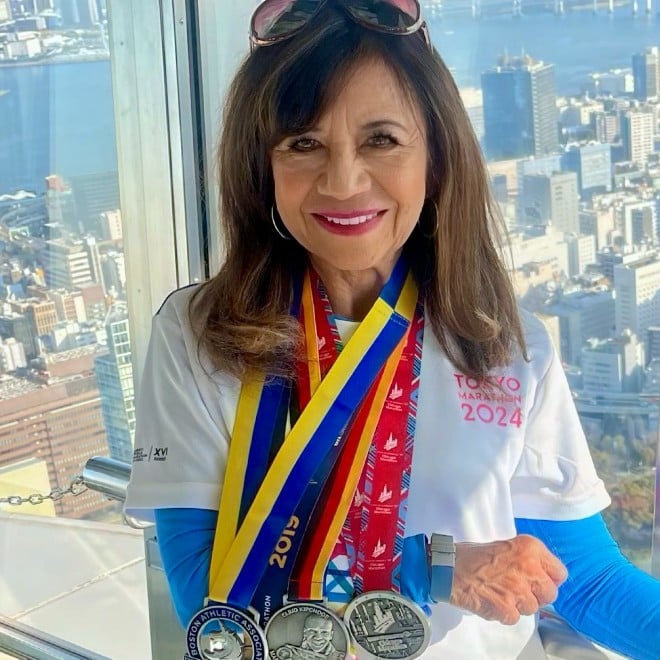
Here is our year in numbers
1 shared vision to stop preventable cancer
Estimated figures show that approximately 40% of cancers could be prevented by modifying key risk factors such as smoking, poor diets, obesity, low physical activity levels, and alcohol consumption.
Our Research Interpretation team have worked hard to deepen our understanding of the factors influencing the risk of developing, and the chance of surviving, a cancer.
5 CUP Global Panel meetings on the risk factors cancer incidence and survivorship
We have met with our CUP Global Expert Panel (a group of world-renowned independent experts from a variety of disciplines) to discuss the scientific evidence that early life body measurements affect later risk of developing breast cancer, as well as the evidence of the impact of physical activity, diet and adiposity (fatness) has on quality of life after a colorectal cancer diagnosis.
We have also formulated new recommendations for the public on the impact of various dietary lifestyle patterns on cancer incidence, following our discussions with the CUP Expert Panel.
99 associations reviewed by the CUP Global experts
There are many modifiable factors that may be associated with developing cancer, or worsen cancer prognosis after diagnosis. This year, we reviewed 99 of them from across the cancer survivorship and cancer incidence evidence.
2 reports published on cancer survivorship
This year, we released 2 reports that summarise the complex evidence on diet, nutrition, physical activity and body weight for people living with and beyond breast and colorectal cancers. Drawing on that evidence and additional inputs from experts, health professional and patients, we produced practical guidance for patients.
We now recommend that, “after a breast cancer diagnosis, people are physically active. However, physical activity should be increased under the supervision of healthcare professionals”. We also outline recommendations for future research, as lots remains to be done in this field.
9 peer-reviewed papers; 5 published, 4 under review.
Five CUP Global peer-reviewed papers have been published this year in academic journals, to share our findings with the scientific community.
Three of them reported on the impact of sedentary behaviour, body fatness, or dietary factors and supplement use after a colorectal cancer diagnosis, while a 4th paper summarised the strength of this evidence. Our CUP Global findings on the effect of dietary and lifestyle patterns and breast cancer incidence were also published in 2024.
Another 4 manuscripts are under peer review. They report on the latest CUP Global work, including the effect of both dietary and lifestyle patterns and early life body size on colorectal cancer risk.
1 new gateway on Health Open Research
Keeping our work transparent is important. A benefit of having a gateway on a site such as Health Open Research is that it allows a central space for us to hold our research outputs and makes them openly available to everyone interested in our work. Check it out here!
16 conferences and events dissemination events
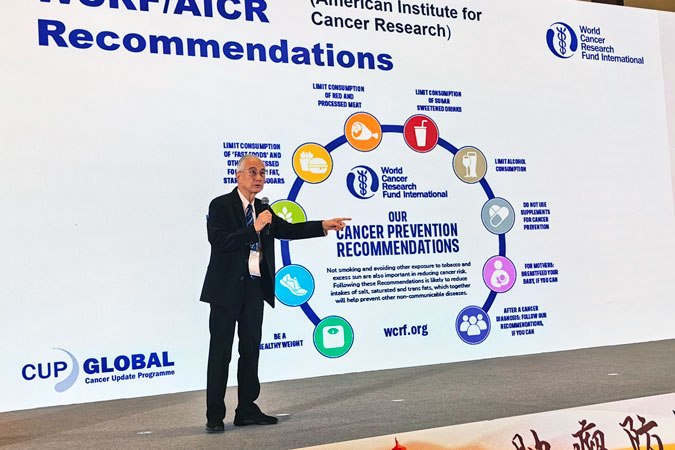
Professor TH Lam speaking at the Chinese Anti-Cancer Conference
Our CUP Global findings were presented on many occasions and to various audiences (the scientific community, health professionals, the public, students and our supporters) across the globe this year.
- At both the World Cancer Congress during a symposium, a rapid firerapid-fire session and a symposium, the 4th Nutrition and Cancer Conference, the Oncology Professional Care conference, and the Chinese Anti-Cancer Conference.
- Throughout 8 lectures at UCL, ICL, and Oxford Brookes, and a 3-day course at Wageningen University & Research
- During a webinar hosted by Breast Cancer Now
- At 2 WCRF supporters’ events in Manchester and Exeter
1 European Code Against Cancer
We contributed to the development of the European Code Against Cancer, an initiative of the European Commission to inform people about key risk factors for cancer.
2 strengthened methodologies
- We have strengthened the way we draw on our collaborators’ expertise when exploring the biology underpinning the link between diet, nutrition, physical activity and body weight, and cancer. This will deepen our understanding of how nutrition-related factors operate inside the human body to influence the onset of cancer.
- CUP Global is also now equipped with a new way of identifying what evidence, among all the research being produced globally, is worth looking at to best strengthen or expand our recommendations for cancer prevention and survival. We have identified 6 topics whose influence on cancer risk will be explored further within CUP Global:
- ultra processed foods,
- tea,
- coffee,
- sugary drinks (including artificial sweeteners),
- soy (isoflavones) and
- sedentary behaviour.
Looking forward to 2025
We will keep disseminating our CUP Global outputs on cancer survivorship dietary lifestyle patterns and on our imminent early life anthropometry findings. This is to ensure that the public, patients, health professionals, researchers and policymakers are informed about actions they can take. We are looking forward to presenting some of this work at the International Congress of Nutrition in Paris, in August 2025.
We won’t stop trying to further our understanding of the modifiable factors that shape the risk of developing, and the chances of surviving, cancer. With the 6 topics identified for CUP Global in 2025, we can’t wait to share findings from this research and learn more about the best way to prevent cancer.
Latest news and blogs
We’re delighted to announce £4m of funding to help more people prevent and survive cancer, in the latest round of grants awarded by World Cancer Research Fund International.
Dr Charlotte Le Cornet is looking at how persistent organic pollutants (POPs) – pollutants that are produced or released during industrial or agricultural processes – affect a woman’s risk of breast and womb cancers. Dr Le Cornet is using data in the European Investigation into Cancer and Nutrition cohort.
Prof Reginald Adjetey Annan is our first ever principal investigator who is from, based in, and researching in Africa. Prof Annan, at Ghana’s Kwame Nkrumah University of Science and Technology, will look at breast cancer among sub-Saharan women. Prof Annan took part in a grant writing course for researchers in Africa organised by Cancer and Nutrition in Africa as an initiative of the International Collaboration on Nutrition in relation to Cancer, which we helped fund in 2023 and 2024.
The grant writing course for researchers in lower- and middle-income countries (LMICs) aims to produce successful grant applications that address unmet needs and focus on understudied populations within these countries. Our investment in such initiatives underscores our commitment to fostering research excellence in LMICs and advancing global health equity.
We fund 2 types of projects: our Regular Grant Programme for established senior scientists, and our INSPIRE Research Challenge for scientists starting out on a career in cancer research.
Our grants are managed by World Cancer Research Fund International on behalf of our network funders: World Cancer Research Fund in the UK, and Wereld Kanker Onderzoek Fonds in the Netherlands. Our network partner, American Institute for Cancer Research, runs a separate grant call for researchers based in the Americas.
Our 2024 Regular Grant Programme awards in full
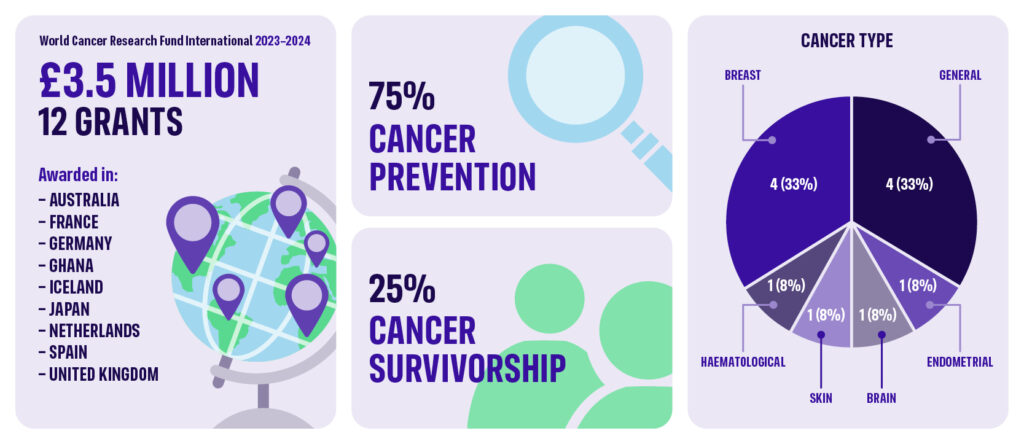
- Associate Prof Kara Britt, University of Melbourne, Australia, £349,995.01: Mapping the impact of obesity on the normal breast
- Dr Laure Dossus, International Agency for Research on Cancer, France, £349,567: Role of perturbations of cholesterol metabolism in breast cancer development
- Assistant Prof Kalijn Bol, Radboud University Medical Center, Netherlands, £349,300: Dietary fibre to induce gut microbiota-mediated response to immunotherapy in melanoma (FIGURE-IM)
- Prof Reginald Adjetey Annan, Kwame Nkrumah University of Science and Technology, Ghana, £348,256.56: Metabolic syndrome, gut microbiome, and breast cancer risk among sub-Saharan African women: the African Breast Cancer Screening (ABCS) study
- Dr Sæmundur Rögnvaldsson, University of Iceland, £340,297: Understanding the role of obesity and nutrition in the development of multiple myeloma from its precursors
- Dr Tammy Tong and Dr Keren Papier, University of Oxford, UK, £317,552.13: ProMAP: mapping diet to cancer through the proteome
- Dr Emma Vincent, University of Bristol, UK, £288,577.63: How does adiposity distribution influence risk of obesity-related cancers? Exploring causality and mechanisms
- Prof Roger Milne, Cancer Council Victoria, Australia, £288,407: Diet, weight and physical activity and risk of glioma: an international cohort study pooling project
- Dr Sarah Abe and Dr Manami Inoue, National Cancer Center, Japan, £285,682: Evaluation of the 2018 WCRF/AICR Cancer Prevention Recommendations for use in Asia using pooled data from the Asia Cohort Consortium
- Dr Charlotte Le Cornet, German Cancer Research Center (DKFZ), £272,589.54: Dietary related persistent organic pollutants (POPs) circulating concentration, BMI, endometrial and breast cancer risk
- Dr Anouk Hiensch, University Medical Centre Utrecht, Netherlands, £250,984.74: Uncovering the underlying mechanisms: deciphering exercise’s impact on cancer-related fatigue in patients with metastatic breast cancer
- Dr Lorena Arribas Bellvitge, Biomedical Research Institute – IDIBELL, Spain, £60,000: Weight management in obese cancer patients during curative active treatment (CANOBESE study)
Our 2024 INSPIRE Research Challenge awards in full
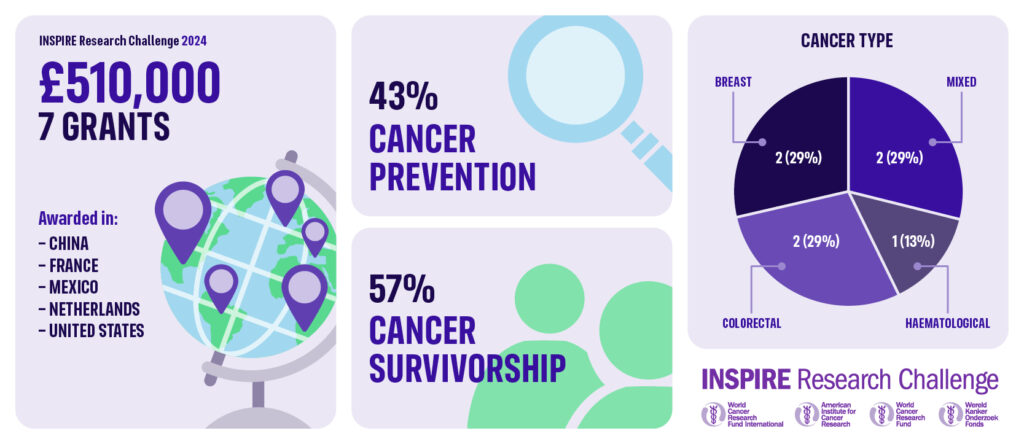
- Dr Forrest Baker, The University of Arizona, US, £75,000: Harnessing γδ t-cell therapies with exercise to treat multiple myeloma
- Dr Fernanda Mesa Chávez, Centro Medico Zambrano Hellion, Mexico £75,000: Online mindfulness-based stress reduction intervention for patients with breast cancer receiving chemotherapy
- Dr Baoting He, University of Hong Kong, China, £75,000: Gut microbiota and cancer risk in east Asians: a two-sample Mendelian randomization study
- Dr Evertine Wesselink, Wageningen University, Netherlands, £74,995: Connecting the dots: examining the relationship between lifestyle, immune-related tumour characteristics and colorectal cancer recurrence
- Dr David van Dijk, Maastricht University, Netherlands, £74,918.64: Insulin resistance as driver of myosteatosis in colorectal cancer
- Dr Felix Onyije, International Agency for Research on Cancer, France, £74,751.20: Occupational night shift work and sleep imbalance and the risk of testicular germ cell tumours in men and ovarian cancer in women
- Dr Yahya Mahamat-Saleh, International Agency for Research on Cancer, France, £60,000: Identification of novel metabolic signatures related to stressful life events and breast cancer risk and survival
A new study funded by World Cancer Research Fund has found that activity throughout the day, with peaks in the morning and late afternoon, correlated with an 11% reduced risk of developing colorectal (also known as bowel) cancer, compared with other patterns of exercise studied.
This study used accelerometer data (which measures movement) to analyse daily activity. It used a statistical method that examines all of the data and finds common patterns, and how those patterns might be related to the risk of colorectal cancer.
Researchers from Regensburg University utilised data from the UK Biobank, which had contacted 86,252 randomly selected individuals (56% of them women), asking them to wear accelerometers to track their movement over 1 week and following them for 5 years to monitor the development of colorectal cancer. When studying the data, researchers identified a 2-peak pattern of daily physical activity associated with reduced colorectal cancer risk.
The researchers identified 4 different patterns of physical activity throughout the day:
- Continuous day-long activity
- Activity later in the day
- Early and late-day activity
- Activity in the middle of the day and during the night
The 3rd pattern, where people were active both in the early and late parts of the day, was associated with an 11% lower risk of colorectal cancer, compared with 6% for day-long activity and no change for middle of the day and the night. Data from activity later in the day only was inconclusive. These findings held true even when considering factors such as smoking, shift work and other variables that could affect a person’s cancer risk.
Impact on sedentary lifestyles
In addition, the researchers found that a day-long activity pattern most effectively reduced colorectal cancer risk among individuals who were more sedentary. This may be because the effect of physical activity becomes more obvious when contrasted with a previously more inactive lifestyle, meaning that those who are fit and healthy are already at a reduced level of cancer risk. These findings show how beneficial physical activity can be, especially in those who are more sedentary.
Dr Helen Croker, Assistant Director of Research and Policy at World Cancer Research Fund, said:
“Being physically active is one of our Cancer Prevention Recommendations, and we know that this cuts cancer risk. These intriguing new findings offer potential for developing more specific recommendations, including patterns and timing of physical activity, for reducing cancer risk. This shows the vital importance of World Cancer Research Fund continuing to support research that expands our knowledge to inform cancer prevention going forwards.”
Prof Michael Leitzmann, Chair of the Department of Epidemiology and Preventive Medicine at the University of Regensburg, Germany, who was the lead investigator in the study, said:
“Our study highlights that not only is physical activity important for reducing colorectal cancer risk, but the timing of peak activity throughout the day could play a crucial role. By identifying specific times – early morning and late day – when physical activity is most beneficial, our findings open new avenues for targeted prevention strategies. If confirmed by future research, this could provide a simple yet impactful way for individuals to further reduce their cancer risk through the timing of their exercise.”
Read the paper
Stein, M.J., Baurecht, H., Bohmann, P. et al. Diurnal timing of physical activity and risk of colorectal cancer in the UK Biobank. BMC Med 22, 399 (2024).
About the UK Biobank
The UK Biobank is a large, population-based prospective study, established to allow detailed investigations of the genetic and non-genetic determinants of the diseases of middle and old age. It has 500,000 UK participants between the ages of 40–69.
About the University of Regensburg
The University of Regensburg is a nationally and internationally renowned comprehensive university with an excellent research spectrum, an attractive range of courses and a high sense of social responsibility. The UR stands for diversity, openness to the world and shaping the future. Its research strength is demonstrated by 6 Collaborative Research Centers funded by the German Research Foundation (DFG) and 9 grants from the European Research Council.
In 2017, the Institute for East and Southeast European Studies (IOS), an affiliated institute of the UR, was the first institution in Regensburg to be accepted into the renowned Leibniz Association, followed in 2022 by the Leibniz Institute for Immunotherapy, which emerged from the Regensburg Center for Interventional Immunology. In May 2024, the Regensburg Center for Ultrafast Nanoscopy opened at the university, where the ultra-fast quantum movements of atoms and molecules are researched using innovative, high-resolution slow-motion cameras. In spring 2022, the Science Council recommended funding for the Center for Immunomedicine in Transplantation and Oncology at the UR, a center for basic research in immunomedicine.
Latest news and blogs
Read more
-
Notes
The review was done by a team led by Dr Dora Romaguera from the Health Research Institute of the Balearic Islands (IdISBa) and Biomedical Research Networking Centre – Physiopathology of Obesity and Nutrition (CIBEROBN).
The CUP Global research team at Imperial College London, led by Dr Doris Chan and Dr Kostas Tsilidis, supported this work.
- New guidance developed with experts including patients and service users
- Our Cancer Prevention Recommendations are beneficial after a cancer diagnosis
- Comprehensive review of evidence and recommendations for future research directions
Two new in-depth scientific reports, launched at the World Cancer Congress in Geneva, bring together a full synthesis of the current evidence on diet, nutrition, physical activity and body weight from World Cancer Research Fund International’s Global Cancer Update Programme (CUP Global) on people living with and beyond breast and colorectal cancers.
For the first time, they present guidance for people living with and beyond breast and colorectal cancers, caregivers and health professionals. The reports also discuss the limitations of the existing research and make recommendations for future research to strengthen the evidence base.
Relevant and accessible
The CUP Global research team at Imperial College London conducted 7 systematic reviews, together assessing many thousands of recent research papers, studies and databases. World Cancer Research Fund convened expert panels, including oncologists and researchers, as well as patients and people with lived experience of cancer, to ensure the guidance is relevant and accessible.
Prof Andrew Renehan, Deputy Chair of the CUP Global Expert Committee on Cancer Survivorship, said:
These reports are the culmination of over 2 years of detailed work by World Cancer Research Fund International and the CUP Global partnership. They are a substantial and significant body of work and represent the best synthesis of our knowledge to date. As well as providing guidance for oncology health professionals and people living with and beyond cancer, they offer a clear direction for researchers seeking to advance the field.
Lynette Hill, Public Representative on the CUP Global panel, said:
Our challenge was to translate the complex findings from so many scientific papers into simple messages for people living with and beyond cancer. This will help health professionals to answer questions and inform their patients about the role of diet, physical activity and body weight, and the importance of these to their future health.
The reports show how nutrition, physical activity and body weight affect survival and recurrence. For people living with and beyond breast cancer, there is strong evidence that a physically active lifestyle improves health-related quality of life and that a diet high in fibre may improve health outcomes. For colorectal cancer, the evidence suggests that physically active lifestyles and a diet rich in wholegrain foods, and avoiding sugary drinks, may improve health outcomes and overall survival.
Key evidence in the reports was recently published in a series of linked papers in the International Journal of Cancer, published by the Union for International Cancer Control (UICC),
Dr Sonali Johnson, Head of Knowledge, Advocacy and Policy at the UICC said:
The guidance provided in these reports is about giving people living with cancer the tools they need to take control of their health. By focusing on practical changes such improving diet, staying active and managing weight, we can help reduce the risk of cancer coming back and improve the quality of life for so many, bringing us closer to a world where fewer lives are lost to cancer, and more people can live healthier, longer lives after diagnosis.
World Cancer Research Fund’s CUP Global is the world’s largest source of scientific research on cancer prevention and survivorship through diet, nutrition, physical activity and body weight. It is funded in partnership with American Institute for Cancer Research, World Cancer Research Fund in the UK and Wereld Kanker Onderzoek Fonds in the Netherlands.
Dr Helen Croker, World Cancer Research Fund International’s Assistant Director of Research and Policy, and Head of the CUP Global Secretariat, said:
As an evidence-based organisation, we have used the best available evidence to develop this process and produce practical guidance on diet, physical activity and body weight for people living with and beyond cancer. We hope this guidance will help support people to live longer, healthier lives.
By highlighting gaps in the evidence base, the reports show where further, high-quality research is needed. These include well-designed clinical trials and prospective cohort studies, as well as understanding the biological mechanisms involved. We hope this will be a springboard for further progress.
Download the reports
> Breast cancer
> Colorectal cancer
Download the executive summaries
> Breast cancer
> Colorectal cancer
Summary guidance in the reports
- Suggests that people living with and beyond breast and colorectal cancers consider increasing their physical activity, under the supervision of health care professionals.
- Suggests that people living with and beyond breast and colorectal cancers consider following as many of WCRF/AICR’s Cancer Prevention Recommendations as they are able.
- People diagnosed with breast cancer should consider:
- increasing their dietary fibre intake.
- avoiding gaining weight during and after treatment (if not underweight).
- People diagnosed with colorectal cancer should consider increasing their dietary intake of wholegrain foods, and reducing their sugary drink intake.
Much of the research in these reports build on the 2014 (updated 2018) report: Diet, nutrition, physical activity and breast cancer survivors, which was published as part of the WCRF/AICR Third Expert Report on the links between lifestyle/modifiable behaviours and cancer. At that time, research on cancer survival was limited, but there was enough evidence to conclude that people living with and beyond cancer should follow our Cancer Prevention Recommendations if they can.
18 September 2024 update
Our findings have been launched at the World Cancer Congress as guidance for people living with and beyond colorectal cancer.
Read the report:
Read the executive summary:
2 May 2024
Our latest findings have been published in the International Journal of Cancer (IJC), presenting research from our Global Cancer Update Programme (CUP Global) – a comprehensive review of the available literature and evidence.
The CUP Global research team at Imperial College London, supported by World Cancer Research Fund International, conducted comprehensive systematic literature reviews and meta-analyses to evaluate the evidence on body fatness, physical activity, sedentary behaviour and diet with predicted outcomes after a colorectal cancer diagnosis.
Overall, the evidence suggested a physically active lifestyle, a diet rich in plant-based foods, wholegrain foods, and coffee, but avoiding sugary drinks, potentially improve outcomes and overall survival.
The quality of the evidence was independently interpreted and graded by the CUP Global Expert Committee on Cancer Survivorship and Expert Panel. The Panel graded the quality of the strongest evidence as “limited-suggestive”, however, the rest was graded “limited-no conclusion”.
Only very few relevant randomised control trials (RCTs) with relevant exposures were identified. Many of the studies available for review were observational, looking at a relatively small sample over a limited time. The authors and Panel flagged the high risk of possible biases including confounding elements, inaccurate exposure measurements, and selection bias (inclusion only of patients with some accumulated survival time).
The authors and Panel are calling for better-designed intervention trials and large, well-designed observational studies with more accurate and repeated exposure and confounder information to strengthen this evidence-base. This will allow them to develop improved recommendations for colorectal cancer survivors.
Dr Helen Croker, Assistant Director of Research and Policy at World Cancer Research Fund International, said:
This comprehensive and rigorous review of the current state of evidence offers useful guidance on some of the diet and lifestyle factors that could improve cancer survival, and potentially help people living with and beyond cancer enjoy longer, healthier lives.
At the same time, it shows a clear need for more well-designed intervention and cohort studies to support the development of robust recommendations for colorectal cancer patients and health professionals. As we are seeing an increase of people diagnosed with colorectal cancer at younger ages, it is more important than ever that health advice is based on high-quality research.
Dr Doris Chan, Senior Research Fellow in Nutrition at Imperial College London, and Dr Kostas Tsilidis, Reader in Cancer Epidemiology and Prevention at Imperial College London – both CUP Global lead researchers – said:
We are delighted that our findings have been evaluated by the Expert Panel and are published today in IJC. We analysed several hundred studies, and although most had limitations and potential biases, we are confident that it represents the best and most up-to-date body of evidence that can assist people living with or beyond cancer in making evidence-based decisions on lifestyle changes that can improve their well-being. We are now moving forward with the next phase of CUP Global, including employing AI-enhanced tools to assist us in our examination of cancer risk factors and prevention strategies.
Prof Rudolf Kaaks, Chair in Cancer Epidemiology at the German Cancer Research Center, is the author of the IJC editorial that accompanies the papers. He wrote:
Through its international Global Cancer Update Programme WCRF takes up a central role in organising international expert reviews to summarise the impact of diet, physical activity and excess body weight which provides reliable recommendations on body weight, physical activity and diet in relation to cancer risk.
WCRF and the Imperial College London research team in charge of the CUP Global evaluations are to be commended for their continuing efforts of summarising findings from nutritional epidemiology studies setting highest possible standards for scientific evaluation.
Prof Kaaks’ editorial also refers to a set of linked papers on breast cancer survival, published by the CUP Global team in 2023.
International Journal of Cancer is a bi-weekly peer-reviewed medical journal, and the official journal of the Union for International Cancer Control (UICC).
Dr Sonali Johnson, Head of Knowledge, Advocacy and Policy at the Union for International Cancer Control, said:
The Union for International Cancer Control commends the World Cancer Research Fund for its rigorous scientific inquiry, further advancing our understanding of cancer survivorship, as well as improving outcomes and the quality of life of people who have had cancer. This study also underscores the importance of robust research and data in informing protocols, policies and national cancer strategies.
Colorectal cancer papers
Post-diagnosis physical activity and sedentary behaviour and colorectal cancer prognosis: a Global Cancer Update Programme (CUP Global) systematic literature review and meta-analysis.
> Read this paper, published in the IJC
Post-diagnosis adiposity, physical activity, sedentary behaviour, dietary factors, supplement use and colorectal cancer prognosis: Global Cancer Update Programme (CUP Global) summary of evidence grading.
> Read the summary of evidence grading in the IJC
Post-diagnosis adiposity and colorectal cancer prognosis: a Global Cancer Update Programme (CUP Global) systematic literature review and meta-analysis.
> Read this paper, published in the IJC
Post-diagnosis dietary factors, supplement use and colorectal cancer prognosis: a Global Cancer Update Programme (CUP Global) systematic literature review and meta-analysis.
> Read this paper, published in the IJC
Editorial:
Breast cancer papers
All 4 previously published papers can be found here:
Post-diagnosis body fatness, recreational physical activity, dietary factors and breast cancer prognosis: Global Cancer Update Programme summary of evidence grading.
> Read the paper published in the IJC
Post-diagnosis recreational physical activity and breast cancer prognosis: Global Cancer Update Programme systematic literature review and meta-analysis.
> Read this paper published in the IJC
Post-diagnosis body fatness, weight change and breast cancer prognosis: Global Cancer Update Programme systematic literature review and meta-analysis.
> Read the paper published in the IJC
Post-diagnosis dietary factors, supplement use and breast cancer prognosis: Global Cancer Update Programme systematic literature review and meta-analysis.
Latest news and blogs
Latest news and blogs
World Cancer Research Fund International has convened a new Science Executive Committee to steer its scientific programmes, including the flagship Global Cancer Update Programme.
Prof Elio Riboli, chair in Cancer Epidemiology and Prevention at the School of Public Health, Imperial College London, will chair the Committee in his new role as World Cancer Research Fund’s International Medical and Scientific Adviser. Dr Panagiota Mitrou, Director of Research, Policy and Innovation at World Cancer Research Fund International, will co-chair the Committee.
The Science Executive Committee will advise on progress, new research directions, dissemination of outputs, policy implications, and opportunities for leverage with stakeholders and partnerships.
‘We must face the reality’
At the inaugural meeting, which took place in London last month, Prof Riboli said:
“I am delighted to be supporting this vital work at a very exciting time. Our understanding of the links between nutrition, weight, physical activity and cancer continues to increase, and there are great opportunities to influence both the direction of research and public health policy.
“At the same time, we must face the reality that in many countries, the trend is for increasing consumption of processed and red meat, sugary foods and drinks, and other unhealthy food. These dietary habits, combined with low levels of physical activity, contribute to the increase in overweight and obesity, and in the incidence of many common chronic diseases around the world. We need to understand and focus on system-level interventions that improve the health of individuals and populations – and this is a huge challenge.”
Dr Mitrou said:
“Prof Riboli is one of the world’s eminent leaders in cancer epidemiology and prevention. We’re delighted that he’s joining World Cancer Research Fund as our Medical and Scientific Adviser. His input will be vital to build on the success of our funded research through our grant programmes and our global expert reports on diet, nutrition and physical activity in relation to cancer prevention and survival. Our ultimate aim is to strengthen our science strategy, explore new directions and translate evidence into policy.”
World Cancer Research Fund International is a leading authority on the links between diet, nutrition, weight, physical activity and cancer. It is in official relations with the World Health Organization (WHO) and works with partners globally to promote policies that prevent cancer and other non-communicable diseases.
Rachael Gormley, CEO of World Cancer Research Fund International, said:
Our vision is a world where no one develops a preventable cancer, and people living with and beyond cancer are enabled to make informed choices and enjoy longer, healthier lives. We can only realise this in partnership with others, taking leadership in some areas and supporting in others. With his experience and eminence in the field, Prof Riboli is a tremendous addition to our team.
The other members of the Committee are:
- Nadia Ameyah (Wereld Kanker Onderzoek Fonds)
- Jennifer Mercer (American Institute for Cancer Research)
- Dr Nigel Brockton (American Institute for Cancer Research)
- Dr Helen Croker (World Cancer Research Fund International)
- Vickie Gregory (World Cancer Research Fund International)
About Prof Riboli
Prof Riboli has made an exceptional impact on the fields of epidemiology, cancer prevention and the fight against chronic illness. Before coming to Imperial, he worked at the International Agency for Research on Cancer, the specialised cancer agency of the WHO, where he initiated groundbreaking research on the role of diet, nutrition and metabolic health in cancer causation and prevention.
He designed and led the establishment of the largest international population cohort studies on nutrition and cancer – the European Prospective Investigation into Cancer and Nutrition (EPIC) – which recruited more than half a million participants, with rich phenotyping data and blood samples stored in the first dedicated large-scale population biobank.
At Imperial, he has continued to lead research on modifiable cancer risk factors, including metabolic syndrome components and inflammation.
In recognition of his achievements, Prof Riboli was elected an Honorary Fellow of the Faculty of Public Health of the Royal College of Physicians and a Fellow of the Academy of Medical Sciences.